MKTMarketsMarket closeCountry analysis NO. ---
Asia Europe markets wrap: Kospi falls 3.73%, IHSG jumps 5.65%
Chip selling hit Seoul and Tokyo, Hong Kong slipped as stimulus hopes faded, and Jakarta bounced hard after its MSCI shock. Europe recovered most of its losses as oil eased. A country-by-country look at the latest session.

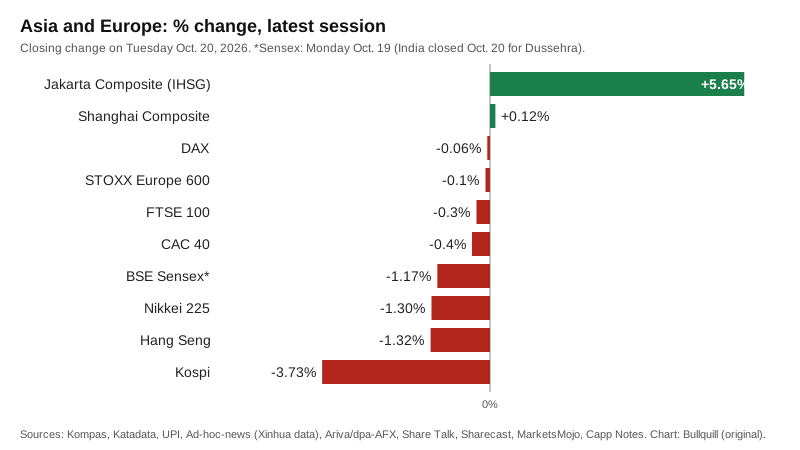
In this Asia Europe markets wrap, South Korea's Kospi dropped 3.73% on Tuesday, October 20, 2026 as investors sold chip stocks, while Jakarta's IHSG jumped 5.65% to 5,278.89. Japan's Nikkei 225 fell 1.30%, and European indexes ended only slightly lower.
For informational purposes only, not financial advice. This article is for general information and education only. It does not take into account your personal circumstances. Bullquill is an independent publication, not a licensed financial adviser, broker or financial institution.
Key takeaways
- Most Asian markets fell on Tuesday even though Wall Street had bounced the night before. South Korea's Kospi dropped 3.73% as foreign and institutional investors sold chip stocks.
- Jakarta was the big exception: the Jakarta Composite Index (IHSG) jumped 5.65% to 5,278.89, rebounding from the worst rout in nearly three decades after MSCI proposed stripping Indonesia of emerging-market status.
- Japan's Nikkei 225 fell 1.30% and Hong Kong's Hang Seng 1.32%. The Shanghai Composite edged up 0.12% after China held its loan prime rates for a 17th month.
- European indexes ended only slightly lower after recovering from intraday losses. Hopes for US–Iran talks pulled oil off its highs, offsetting French unrest and a weaker German ZEW survey.
- Next up: UK inflation data and Bank Indonesia's rate decision on October 21, Asian tech earnings sentiment after Wednesday's US reports, and the Fed on October 27–28.
The scoreboard
| Market | Index | Close | Change (%) | Main driver |
|---|---|---|---|---|
| Japan | Nikkei 225 | 64,075.42 | -1.30% | SoftBank and AI-linked names fell; higher yields |
| South Korea | Kospi | 5,552.74 | -3.73% | Foreign and institutional selling of chip stocks |
| Hong Kong | Hang Seng | 23,867.74 | -1.32% | Tech and financials fell; fewer stimulus hopes |
| Mainland China | Shanghai Composite | 3,735.37 | +0.12% | GDP beat; loan prime rates held |
| Indonesia | Jakarta Composite (IHSG) | 5,278.89 | +5.65% | Rebound after MSCI-driven sell-off |
| India | BSE Sensex (Oct. 19) | 73,852.90 | -1.17% | Financials led losses before holiday |
| Europe | STOXX Europe 600 | 638.64 | -0.1% | Oil eased; French unrest weighed |
| Germany | DAX | 25,304.42 | -0.06% | Weaker ZEW; recovered on US–Iran hopes |
| United Kingdom | FTSE 100 | 10,733.00 | -0.3% | Banks fell as jobs data raised BoE hike bets |
| France | CAC 40 | 7,838.49 | -0.4% | Civil unrest and curfews |
Sources: Nikkei: Capp Notes (BBN Times gives 64,075.37). Kospi: UPI. Hang Seng and Shanghai: Ad-hoc-news (Xinhua data) and Antara. IHSG: Kompas, Katadata and Antara. Sensex: MarketsMojo. STOXX 600 and CAC 40: Sharecast and Capp Notes. DAX: Ariva/dpa-AFX. FTSE 100: Share Talk.
Asia: country by country
South Korea: chip selling resumes
The Kospi had the region's worst day. It fell 215.27 points to 5,552.74 after touching an intraday low of 5,493.24, which erased the gains of the two previous sessions. UPI reported that foreign investors sold a net 542 billion won and institutions 998 billion won on the main board. Retail investors bought a net 901 billion won. Samsung Electronics fell 2.98% and SK Hynix 4.23%. The tech-heavy Kosdaq lost 3.33%.
Korean shares fell even though US chipmakers rallied overnight: UPI noted the Philadelphia Semiconductor Index rose 1.61% on Monday. UPI and other reports gave several reasons: doubts about whether huge AI investments will pay off, US 10-year yields above 5.1%, political and fiscal strains in Europe, and profit-taking. Newsquawk also pointed to reports that US tech firms were pressing for lower memory-chip prices, a direct concern for Korea's two memory giants. Analysis: because so much of the Kospi's weight sits in two memory makers, Korea tends to swing most when sentiment about the AI hardware cycle shifts.
Japan: SoftBank weighs on the Nikkei
The Nikkei 225 fell about 841 points, or 1.30%, to 64,075.42. BBN Times reported that SoftBank Group fell about 6%, making it the largest drag on the index, while chip tester Advantest slipped. Reports linked the selling to rising bond yields and doubts about AI financing. With USD/JPY around 158, the weak yen did not provide enough support. The index remains well below the all-time high it set in June.
Hong Kong and mainland China: growth beats, no new stimulus
The Hang Seng lost 319.09 points, or 1.32%, on its first session after a holiday. The Hang Seng Tech index fell 1.52%. Lenovo fell 10%, and CATL fell 6.6% ahead of its third-quarter results, according to Ad-hoc-news. On the mainland, the Shanghai Composite added about 4 points to 3,735.37.
The People's Bank of China left the one-year loan prime rate at 3.0% and the five-year at 3.5%, its 17th straight month without a change. Ad-hoc-news, citing official data, reported that China's third-quarter GDP grew 4.5% year on year, ahead of the 4.4% consensus and up from 4.3% in the second quarter. Analysis: stronger growth lowers the chance of new stimulus, and markets that had been counting on support from Beijing took the news coolly.
Indonesia: a rebound after the shock
Jakarta's 5.65% gain, a rise of 282.28 points, came after two of the worst days in the market's modern history. On October 15 (New York time), MSCI opened a consultation on reclassifying Indonesia from Emerging Market to "Standalone" status, saying the current classification is "no longer appropriate." The IHSG then fell about 11.6% on October 16 and another 3.6% on October 19.
Tuesday's rally was broad. Kompas reported 694 stocks up and 111 down, with all 11 sectors higher. Transport rose 8.55%, and the large-cap LQ45 index gained 8.58%. Turnover was about Rp26.5 trillion. Foreign investors still sold a net Rp2.19 trillion on the day, according to Katadata, taking year-to-date net foreign selling to Rp92.11 trillion. A market observer quoted by Antara called the move mainly a "technical rebound" and said market risk had not yet fully eased. We look at the capital-flow side of this story in a separate analysis.
India: closed for Dussehra
Indian equity markets were shut on October 20. In Monday's session the Sensex fell 876.37 points, or 1.17%, to 73,852.90, and the Nifty 50 fell 1.11% to 22,888.95. Financial stocks led the decline. MarketsMojo noted that the Nifty closed just 3.1% above its 52-week low. Trading resumes with global cues from two sessions to absorb.
Europe: off the lows
European markets spent much of the day lower, then recovered most of their losses by the close. The DAX fell to near 25,000 during the session but finished at 25,304.42, down just 0.06%. According to dpa-AFX, it was helped by rumors of a compromise proposal from Qatar and Pakistan, acting as mediators between the United States and Iran, and by falling oil and gas prices. Earlier, the ZEW economic sentiment index fell 6.6 points to 28.1 in October, Ad-hoc-news reported. Germany's producer prices rose 6.7% year on year in September, the fastest since March 2023, according to Capp Notes. The Euro Stoxx 50 lost 0.38% to 6,121.66.
In London, the FTSE 100 fell 31.69 points to 10,733.00 after a low of 10,673.02. UK unemployment unexpectedly fell to 4.7% in the three months to August, and Share Talk reported that the data strengthened expectations of a Bank of England rate rise in November. Banks fell on the data. Oil pulled back from the level reached on October 19, when Brent topped $110 a barrel, according to Oilprice.com. December Brent futures were at $108.79 at the US close, according to Capp Notes.
France underperformed. The CAC 40 lost about 0.4% to 7,838.49. After weekend cost-of-living protests turned violent, authorities imposed overnight curfews around Place de la République and the Les Halles shopping district in Paris and introduced restrictions in Lyon and other cities, CBS News reported. Luxury retail was among the businesses affected, according to Sharecast.
| Indicator | Reading | Context | Source |
|---|---|---|---|
| Germany ZEW economic sentiment (Oct.) | 28.1 | Down 6.6 points | Ad-hoc-news |
| Germany producer prices (Sept., y/y) | +6.7% | Fastest since March 2023 | Capp Notes |
| UK unemployment rate (3 months to Aug.) | 4.7% | 4.9% expected | Share Talk |
| UK average total earnings growth | 3.7% | Down from 3.9%; 3.8% expected | Share Talk |
| Brent crude, December futures (US close) | $108.79 | Topped $110 on Oct. 19 | Capp Notes; Oilprice.com |
Why it moved
Three themes connected the region's moves on Tuesday:
- AI hardware sentiment. In Asia, chip and AI-linked stocks fell even though US chipmakers had rallied overnight. That points to concerns specific to Asian suppliers, such as memory pricing and how the AI build-out is financed, rather than a general move away from risk.
- Oil and geopolitics. Brent near $110 kept pressure on markets that import energy. Unconfirmed reports of US–Iran mediation pulled prices down during European hours, which helped indexes there recover.
- Rates. High US long-term yields (the 10-year Treasury par yield was 5.15% on October 19 and 5.12% on October 20) and stronger-than-expected UK jobs data kept expectations of tighter policy alive.
What it means
Analysis. The spread between Jakarta's 5.65% gain and Seoul's 3.73% loss on the same day shows that country-specific factors, such as index-provider decisions and market structure, can matter as much as global sentiment. For Indonesia, the rebound came while foreign investors were still selling, which suggests it was driven mainly by local buyers. For Korea and Japan, the question is whether this week's US tech earnings ease or deepen doubts about AI spending. Europe's ability to recover intraday suggests investors there are reacting quickly to news on energy.
Follow-up coverage: why the IHSG still sits 41% below its January record as foreign selling persists, our India stocks brief for October 22 as Brent topped $111, and the Europe stocks brief for October 22 on the AI selloff, oil and French yields.
What to watch next
- Bank Indonesia, October 21: economists surveyed by Indonesian media were split between a hold at 5.75% and a 25-basis-point rise.
- UK CPI, October 21: September inflation data will shape expectations for a Bank of England move in November.
- US tech earnings: Meta, Tesla, IBM, Lam Research and Texas Instruments report after the US close on Wednesday, which will matter for Asian chip supply chains.
- CATL results and further mainland earnings; any shift in Beijing's policy tone after the GDP beat.
- France: how the unrest and curfews develop, and their effect on French government bond spreads.
- The Fed, October 27–28, and the Bank of England in November.
Data notes
Some intraday reports gave different figures. For example, one early AP report put the Kospi down about 4% at 5,539.05, and one report put Shanghai down 0.1%. We used the closing figures that at least two sources, or the official data cited by them, agree on. The Sensex figure is from October 19 because Indian markets were closed on October 20. Bullquill will correct any figure that differs from official exchange data.
Risk warning: Stocks are high-risk. Their value can fall, and you could lose some or all of the money you invest. Do your own analysis before deciding to use any product mentioned here, and bear in mind that it is not suitable for everyone. Past performance does not guarantee future results.
Frequently asked questions
Why did South Korea's Kospi fall 3.73% on October 20, 2026?
Foreign and institutional investors sold a combined 1.54 trillion won of shares, according to UPI, led by chip stocks such as Samsung Electronics and SK Hynix. Reports cited doubts about AI investment returns, high US yields, European political strains and profit-taking.
Why did Indonesia's IHSG rise 5.65% after a crash?
It was a rebound after the index fell about 11.6% on October 16 and 3.6% on October 19, following MSCI's proposal to reclassify Indonesia as a Standalone market. Analysts quoted by Antara called it mainly a technical rebound, and foreign investors were still net sellers on the day.
Were Indian markets open on October 20, 2026?
No. NSE and BSE equity segments were closed for Dussehra. In the previous session, on October 19, the Sensex fell 1.17% to 73,852.90.
What moved European stocks?
European indexes recovered from intraday losses as oil prices eased on unconfirmed reports of US–Iran mediation by Qatar and Pakistan. A weaker German ZEW survey, French civil unrest and UK jobs data that raised Bank of England hike expectations were headwinds.
Sources
- UPI: South Korea's Kospi plunges 3.73%, erasing two-day rebound
- Kompas: IHSG closes up 5.65% at 5,278.89 (in Indonesian)
- Katadata: IHSG rises 5.65% as foreigners net sell Rp2.19 trillion (in Indonesian)
- Antara: IHSG closes 5.6% higher on post-correction buying (in Indonesian)
- Ad-hoc-news: Hang Seng loses 319 points as tech stocks and banks slide
- Ad-hoc-news: Shanghai Composite gains 4 points after GDP data
- Capp Notes: Closing Look, Tuesday, October 20, 2026
- BBN Times: Nikkei 225 drops to 64,075.37 as SoftBank sinks 6%
- Newsquawk: Daily European Equity Opening News, October 20, 2026
- Ariva / dpa-AFX: Aktien Frankfurt Schluss, October 20, 2026 (in German)
- Share Talk: FTSE 100 falls as oil prices retreat despite stronger UK jobs data
- Sharecast: Europe close, October 20, 2026
- Oilprice.com: Brent tops $110 as tanker attacks threaten Persian Gulf supply (Oct. 19, 2026)
- CBS News: French government extends curfews after riots sweep across the country
- MarketsMojo: Sensex and Nifty slip as financials drag
- HDFC Sky: NSE/BSE holiday on October 20 for Dussehra
- MSCI (via Business Wire/Finviz): consultation on reclassifying Indonesia
This article is for information only and is not investment advice.


