MKTMarketsMarket close NO. ---
Wall Street close: Dow rises 1.02% as Russell 2000 gains 1.65%
Industrial and defense earnings beats from 3M and Northrop Grumman, plus a modest pullback in oil, lifted the Dow by 529.85 points while large technology stocks held the Nasdaq near flat. Yields, housing data and the week ahead.

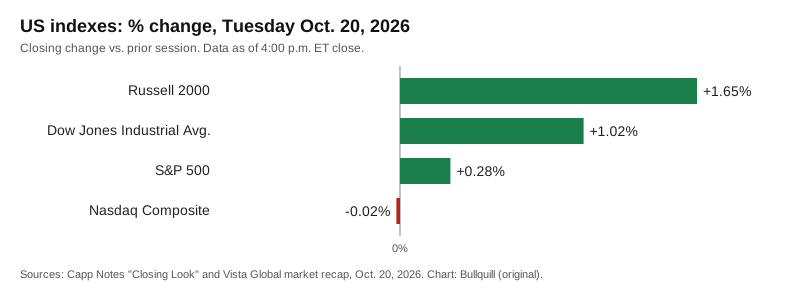
At the Wall Street close on Tuesday, October 20, 2026, the Dow Jones Industrial Average rose 529.85 points, or 1.02%, to 52,495.88, and the Russell 2000 gained 1.65%. The S&P 500 added 0.28%, while the Nasdaq Composite slipped 0.02% as large technology stocks lagged.
For informational purposes only, not financial advice. This article is for general information and education only. It does not take into account your personal circumstances. Bullquill is an independent publication, not a licensed financial adviser, broker or financial institution.
Key takeaways
- The Dow Jones Industrial Average rose 529.85 points, or 1.02%, to 52,495.88. The S&P 500 added 0.28% to 7,712.57, and the Nasdaq Composite slipped 0.02% to 26,424.82.
- Small caps led: the Russell 2000 gained 1.65%. On the NYSE, advancing issues outnumbered decliners by roughly three to one.
- Gains came from health care, real estate and financials, plus individual industrial and defense earnings beats (3M, Northrop Grumman). A modest pullback in oil helped, and large technology stocks lagged.
- The 10-year Treasury yield eased to 5.12% from 5.15%. The 2-year rose to 4.79%, so the gap between the two narrowed.
- US housing data was weak. Housing starts fell 5.2% in September, and pending home sales dropped to the lowest level in records going back to 2001.
- Next up: Tesla, Meta and IBM report after Wednesday's close, and the Federal Reserve meets on October 27–28.
What happened in the session
Tuesday's session moved money away from the largest technology names and into the rest of the market. The Dow, which is weighted by share price and heavy in industrial and financial companies, gained more than 500 points. The S&P 500 finished modestly higher. The tech-heavy Nasdaq Composite ended almost unchanged. The broadest gains were in smaller companies: the Russell 2000 rose 1.65%, the strongest of the main US benchmarks.
The same pattern shows in the equal-weight version of the S&P 500, which gives every company the same weight regardless of size. According to the Capp Notes closing summary, it rose 1.15%, about four times the gain in the standard cap-weighted index. When the average stock beats the index by that much, the biggest companies are usually holding the index back. On Tuesday they did.
| Index | Close | Change (points) | Change (%) |
|---|---|---|---|
| Dow Jones Industrial Average | 52,495.88 | +529.85 | +1.02% |
| S&P 500 | 7,712.57 | +21.84 | +0.28% |
| Nasdaq Composite | 26,424.82 | -6.07 | -0.02% |
| Russell 2000 | 2,773.41 | +45.12 | +1.65% |
| Philadelphia Semiconductor Index | 11,283.81 | n/a | -0.29% |
| Cboe Volatility Index (VIX) | about 17.3–17.4 | about -1.0 | -5.4% to -6.1% |
Sources: Vista Global and Capp Notes, October 20, 2026. Both sources give the same closing levels for the Dow, S&P 500 and Nasdaq. For the VIX they differ slightly (17.44 vs. 17.31), so we show a range.
Market breadth was strong. Capp Notes counted 1,614 advancing issues against 559 decliners on the New York Stock Exchange. The VIX, often described as Wall Street's "fear gauge," fell about 1 point to the mid-17s.
Sector performance
The sector moves fit the rotation. Health care led, and rate-sensitive groups such as real estate and utilities also rose, helped by the dip in long-term yields. Technology was the only sector in the red.
| Sector | Change (%) |
|---|---|
| Health Care | +2.37% |
| Real Estate | +1.70% |
| Utilities | +1.26% |
| Financials | +1.20% |
| Consumer Discretionary | +0.91% |
| Consumer Staples | +0.62% |
| Materials | +0.55% |
| Energy | +0.25% |
| Communication Services | +0.09% |
| Industrials | +0.07% |
| Technology | -0.28% |
Source: Capp Notes closing summary, October 20, 2026. Sector figures are ETF proxies, not official S&P sector index closes, and come from a single source.
Bonds, the dollar and commodities
The Treasury curve flattened. The 2-year yield, which tracks expectations for Fed policy, rose 2 basis points. Yields from 10 years out fell. Long-term yields are still very high by the standards of the past two decades: the 10-year was at 5.24% on October 1 and has eased only slightly this month.
| Maturity | Oct. 1, 2026 | Oct. 19, 2026 | Oct. 20, 2026 | Daily change |
|---|---|---|---|---|
| 3-month | 4.17 | 4.27 | 4.26 | -0.01 |
| 2-year | 4.78 | 4.77 | 4.79 | +0.02 |
| 10-year | 5.24 | 5.15 | 5.12 | -0.03 |
| 30-year | 5.61 | 5.48 | 5.42 | -0.06 |
Source: US Department of the Treasury, Daily Treasury Par Yield Curve Rates, October 2026.
| Asset | Level | Change | Source |
|---|---|---|---|
| WTI crude, December futures | about $98 per barrel ($97.99–$98.28) | -0.3% to -0.6% | Vista Global; Capp Notes |
| Brent crude, December futures | $108.79 per barrel | -0.69% | Capp Notes |
| Gold | about $4,141–$4,143 per ounce | about -0.4% | Vista Global; Capp Notes |
| US Dollar Index (DXY) | 101.71 | -0.26% | Capp Notes |
| USD/JPY | 158.14 | n/a | Capp Notes |
| Bitcoin | about $82,500–$82,800 | +0.8% to +0.9% | Vista Global; Capp Notes |
The two sources took their oil, gold and bitcoin prices at slightly different times, so we show ranges rather than a single figure.
Why it moved
1. Earnings from industrial and defense companies
Third-quarter results drove much of the day. According to Vista Global, 3M reported adjusted earnings per share of $2.50, against estimates of $2.38, and raised its full-year guidance. Its shares rose 5.78% and led the Dow. Northrop Grumman beat on earnings per share ($7.89 vs. $7.18 expected) while revenue came in slightly short, and the stock rose 4.57%. Equifax and Hasbro both gained more than 11%, according to Capp Notes.
Not every beat was rewarded. General Motors topped forecasts for revenue ($50.0 billion vs. $48.52 billion) and adjusted earnings per share ($3.70 vs. $3.57), and it authorized a $20 billion share buyback. But it narrowed its profit outlook, and the stock fell by roughly 7%. Reported closing declines range from 6.84% to 7.5%, depending on the source and the time of the snapshot. GE Aerospace and Genuine Parts also fell after their reports.
The largest single move came from a deal. Braze jumped about 52% after Salesforce agreed to buy it for $47.50 a share in cash, a transaction Vista Global values at about $5.66 billion. The deal still has to close.
2. Oil eased from five-month highs
Energy prices are still the market's biggest macro worry. On October 19, Oilprice.com reported that Brent had briefly topped $110 a barrel, its highest in five months, after renewed attacks on tankers in the Strait of Hormuz. Citing Kpler data reported by Reuters, it said there had been at least 18 tanker attacks in two weeks. Average daily oil flows out of the Gulf fell to 8.5 million barrels, from more than 20 million two weeks earlier.
On Tuesday prices pulled back somewhat. German news agency dpa-AFX, as published by Ariva, linked the move to unconfirmed reports that Qatar and Pakistan, acting as mediators, had floated a compromise proposal between the United States and Iran. Brent still closed near $109, so the pullback was small and the risk premium in oil remains large.
3. Weak housing data
Housing data showed how much high rates are weighing on the economy. September housing starts fell 5.2% to an annualized 1.22 million, below the 1.30 million consensus. Single-family permits fell to their lowest since 2023. Pending home sales dropped 7.3% month over month to a record low in data going back to 2001. Vista Global put average mortgage rates near 7.43%. Homebuilders rose anyway. Analysis: one plausible reading is that investors focused on the drop in long-term yields rather than on the weak data itself. On Oct. 22, Trump signed an executive order on mortgage costs that targets PMI and title fees.
4. Technology and AI-financing worries
The largest technology companies held the indexes back. Semiconductor-equipment names such as Lam Research (-3.21%) and KLA (-2.80%) fell, along with Arm (-3.07%) and Meta (-1.59%), according to Capp Notes. Nvidia slipped 0.29% to $216.47, according to Vista Global. Vista Global also noted continued concern about how the AI infrastructure build-out is being financed, including elevated costs to insure CoreWeave's debt against default.
What it means
Analysis. One session does not make a trend. Still, Tuesday showed three forces that have shaped the market this autumn:
- Breadth versus concentration. When megacap tech stalls, gains in the rest of the market can still lift the Dow and the Russell 2000. Investors are now watching whether this rotation lasts beyond one day.
- Rates are the backdrop. The Fed raised its target range to 3.75%–4.00% on September 16, 2026. Market-based gauges cited by Capp Notes put the chance of a hold at the October 27–28 meeting at around 85%–87% (Kalshi: 87% hold; CME FedWatch: 14.9% hike odds). Vista Global reports that futures still price a substantial chance of quarter-point hikes in December and March 2027. These are market estimates, not policy decisions.
- Energy is the swing factor. Oil near $100 feeds into inflation expectations and, through them, into yields. In its September statement the Fed said that "Inflation remains elevated." The minutes pointed to energy prices driven by geopolitical events as a key concern.
How any of this affects a given household or portfolio depends on its own exposure to borrowing costs, energy prices and equity markets. This article does not assess any individual security.
Later in the week: our US stocks brief for October 22 covers the day the Nasdaq sank 2.6% on AI costs, explained in more depth in why AI spending worries hit chip stocks and the Nasdaq. In healthcare, Moderna and Merck shares fell as melanoma vaccine data surfaced early.
What to watch next
- Wednesday, October 21, before the open: results from Abbott, NextEra Energy, AT&T, Thermo Fisher, Danaher, Philip Morris, Elevance Health, CME Group and Moody's (schedule per Capp Notes).
- Wednesday after the close: Tesla, Meta, IBM, Lam Research, Texas Instruments, SAP, CSX, Las Vegas Sands and Kinder Morgan. Investors will be listening for comments on AI capital spending.
- After-hours moves from Tuesday: Capp Notes reported Netflix down about 5.7% and Intuitive Surgical down about 7.1% in extended trading, with Capital One up about 4.5%. Extended-hours prices often change by the next open. Sources also differ on SpaceX's after-hours move after its first results as a listed company: Vista Global reported about +1.5% and Capp Notes about +4.8%.
- Energy data: the US Energy Information Administration's weekly crude inventory report at 10:30 a.m. ET on Wednesday, plus any confirmed news on Gulf shipping or US–Iran talks.
- Overseas: UK September consumer price data on October 21. Bank Indonesia's policy decision on October 21 is also due, after a sharp sell-off in Jakarta last week.
- The Fed: the FOMC meets on October 27–28. Officials are in their pre-meeting blackout period, so there will be no Fed speeches before then.
For how the week ended, see our US stocks brief for Oct. 23.
Data notes
Closing levels for the three main indexes match across two independent recaps, and the point changes are internally consistent. A third summary, from 24/7 Wall St, gave slightly different percentage changes (S&P 500 +0.22%, Dow +0.95%), probably because it was captured at a different time. We used the figures the two recaps agree on. Sector, breadth, dollar and some commodity figures come from a single recap and are labeled as such. Bullquill will correct any figure that differs from official exchange data.
Risk warning: Stocks are high-risk. Their value can fall, and you could lose some or all of the money you invest. Do your own analysis before deciding to use any product mentioned here, and bear in mind that it is not suitable for everyone. Past performance does not guarantee future results.
Frequently asked questions
How did the main US stock indexes close on October 20, 2026?
The Dow Jones Industrial Average rose 529.85 points (1.02%) to 52,495.88, the S&P 500 gained 0.28% to 7,712.57, and the Nasdaq Composite slipped 0.02% to 26,424.82. The Russell 2000 small-cap index rose 1.65%.
Why did the Dow outperform the Nasdaq?
Gains came from health care, real estate and financials, plus individual industrial and defense earnings beats (3M, Northrop Grumman). Large technology and semiconductor-equipment stocks lagged amid concerns about AI spending and its financing, which held back the Nasdaq.
What did Treasury yields do?
According to official US Treasury data, the 10-year par yield fell to 5.12% from 5.15%, the 30-year fell to 5.42% from 5.48%, and the 2-year rose to 4.79% from 4.77%, a flattening of the curve.
What is the next Federal Reserve meeting?
The FOMC meets on October 27–28, 2026. The target range is 3.75%–4.00% after a September 16 increase. Market-based gauges cited in closing recaps priced a hold as the most likely outcome, but these are estimates, not decisions.
Is this article a recommendation to buy or sell stocks?
No. It explains what happened in markets and why, using published data. It does not recommend any security or strategy and is not investment advice.
Sources
- Capp Notes: Closing Look, Tuesday, October 20, 2026
- Vista Global: Stock Market Today, October 20, 2026
- 24/7 Wall St: S&P 500 closes up as money rotates from tech into value
- US Treasury: Daily Treasury Par Yield Curve Rates, October 2026
- Oilprice.com: Brent tops $110 as tanker attacks threaten Persian Gulf supply (Oct. 19, 2026)
- Ariva / dpa-AFX: Aktien Frankfurt Schluss, October 20, 2026
- Federal Reserve: FOMC statement, September 16, 2026
- Federal Reserve: FOMC meeting calendar
This article is for information only and is not investment advice.


