AIAIExplainer NO. ---
Gemini 4 Argon vs GPT-6 Astra and Opus 5.5: benchmarks, prices
On Google's own table, Argon tops most rows against GPT-6 Astra and Claude Opus 5.5 but trails on several, including Terminal-bench 4.0 and OSWorld-2.0. It also offers a 1,048,576-token context window.

Key takeaways
- Google announced Gemini 4 Argon on September 30, 2026 and opened it to Google AI Pro and Ultra subscribers and paid API customers on October 13. The API model ID is
gemini-4-argon. - On Google's own comparison table, Argon posts the top score on most rows against OpenAI's GPT-6 Astra and Anthropic's Claude Opus 5.5 and Fable 5.1, but trails on Terminal-bench 4.0, FrontierSWE v2, Terminal-Bench Science, PostTrainBench and OSWorld-2.0.
- Price is the sharper weapon. Argon costs $2 per million input tokens and $10 per million output tokens through November 30, 2026, then $4 and $20. GPT-6 Astra lists at $10 and $50; Opus 5.5 at $4 and $20.
- Argon has a 1,048,576-token context window shared between input and output, and a "long decode" mode that can produce up to about 1 million output tokens in a single background job.
- All headline benchmark numbers here are self-reported by the companies, and the vendors' tables disagree with each other on the same models. Treat them as directional.
Gemini 4 Argon, which Google opened to paying users on October 13, tops most rows of Google's own benchmark table against GPT-6 Astra and Claude Opus 5.5, and costs $2 per million input tokens and $10 per million output tokens through November 30. To lower a monthly bill with caching, batch discounts and model routing, see our guide on how to reduce LLM API costs.
What Google released, and when
Google DeepMind's announcement, published on September 30 under the name of Koray Kavukcuoglu, its chief AI architect, described a phased rollout. Argon first went to a vetted group of cyber defenders through what Google calls the Fairwind Program, and Google said that version was released without its usual cyber guardrails to those trusted users and internal teams. Google also said it was participating in the US government's voluntary pre-release access process. As the company put it, "Safely releasing frontier capabilities at this level requires a phased approach."
Broad access followed on October 13. Google's product blog said Pro and Ultra subscribers could use Argon in the Gemini app, alongside a new Tasks feature that lets Gemini keep working across connected apps and an agentic coding interface from Google Antigravity inside the Gemini macOS app. Developers can call it through the Gemini API and Google AI Studio on the paid tier; Google's pricing page says Argon is not available on the free tier.
Google's launch post leaned on practical demonstrations as well as scores. It said a Rust port of the libgav1 video decoder rewritten by Argon agents decodes video 2.7 times faster than the original port, and that Argon agents working on an internal memory-efficiency project identified optimizations expected to free more than 300 TiB. Those are Google's internal results and have not been independently reproduced.
The specs side by side
| Item | Gemini 4 Argon | GPT-6 Astra | Claude Opus 5.5 |
|---|---|---|---|
| Released | Announced Sept. 30; broad access Oct. 13, 2026 | Early September 2026 | Sept. 22, 2026 |
| Input price (per 1M tokens) | $2.00 to Nov. 30, then $4.00 | $10.00 | $4.00 |
| Output price (per 1M tokens) | $10.00 to Nov. 30, then $20.00 | $50.00 | $20.00 |
| Cached input (per 1M tokens) | $0.10, then $0.20 (implicit caching only) | $1.00 | $0.20 (cache read); $5 cache write |
| Context window | 1,048,576 tokens, shared with output | 1,050,000 tokens | Not stated per model on the pricing page ("up to 1M") |
| Max output | 65,536 by default; up to 1,048,576 with long decode | 128,000 tokens | Not stated in sources reviewed |
| Knowledge cutoff | Not stated | April 30, 2026 | Not stated in sources reviewed |
| Inputs | Text, image, video, audio, PDF | See OpenAI docs | See Anthropic docs |
Sources: Google AI for Developers model and pricing pages (last updated Oct. 14 and Oct. 19, 2026); OpenAI developer docs for GPT-6 Astra; Anthropic's Opus 5.5 announcement and Claude pricing page. Prices are standard tier, US dollars.
Two details are easy to miss. First, Argon's "1M context" is a single budget shared by input and output, so a very long prompt leaves less room for the answer. Second, Google's introductory price is temporary: from December 1, Argon costs the same per token as Opus 5.5. Batch and Flex processing on Argon cost half the standard rate, and Priority costs more. Our explainer what is a context window covers how tokens, 1M-token limits and recall work.
The benchmark table, and its caveats
Google's model page compares Argon with GPT-6 Astra, Claude Fable 5.1 and Claude Opus 5.5 on 19 rows, grouped into eight areas: knowledge work, agentic coding, machine-learning engineering, science and math, long context, computer use, multimodal understanding and cybersecurity. The selection below covers most of those areas. All figures are Google's.
| Benchmark (Google's table) | Gemini 4 Argon | GPT-6 Astra | Claude Fable 5.1 | Claude Opus 5.5 |
|---|---|---|---|---|
| Vals Index (knowledge work) | 68.9% | 63.1% | 65.8% | 67.0% |
| AutomationBench | 51.3% | 41.4% | 31.4% | 42.5% |
| DeepSWE v1.1 (agentic coding) | 77.9% | 74.1% | 67.4% | 74.2% |
| FrontierSWE v2 | 55.0% | 65.5% | 56.3% | 62.3% |
| Terminal-bench 4.0 | 57.4% | 58.2% | 57.9% | 66.4% |
| Terminal-Bench Science 0.1 | 57.6% | 68.1% | 52.6% | 63.3% |
| GraphWalks BFS, 256k to 1M (F1) | 84.2% | 71.8% | 65.0% | 66.8% |
| LVBench (video understanding) | 91.7% | 87.5% | 79.7% | 83.7% |
| Agent's Last Exam (computer use) | 39.5% | 34.2% | n/a | 38.2% |
| CWE-bench v1 (cybersecurity) | 68.0% | 68.0% | 58.0% | 67.0% |
Source: Google DeepMind, Gemini model page, self-reported results. Bold marks the top score in each row.
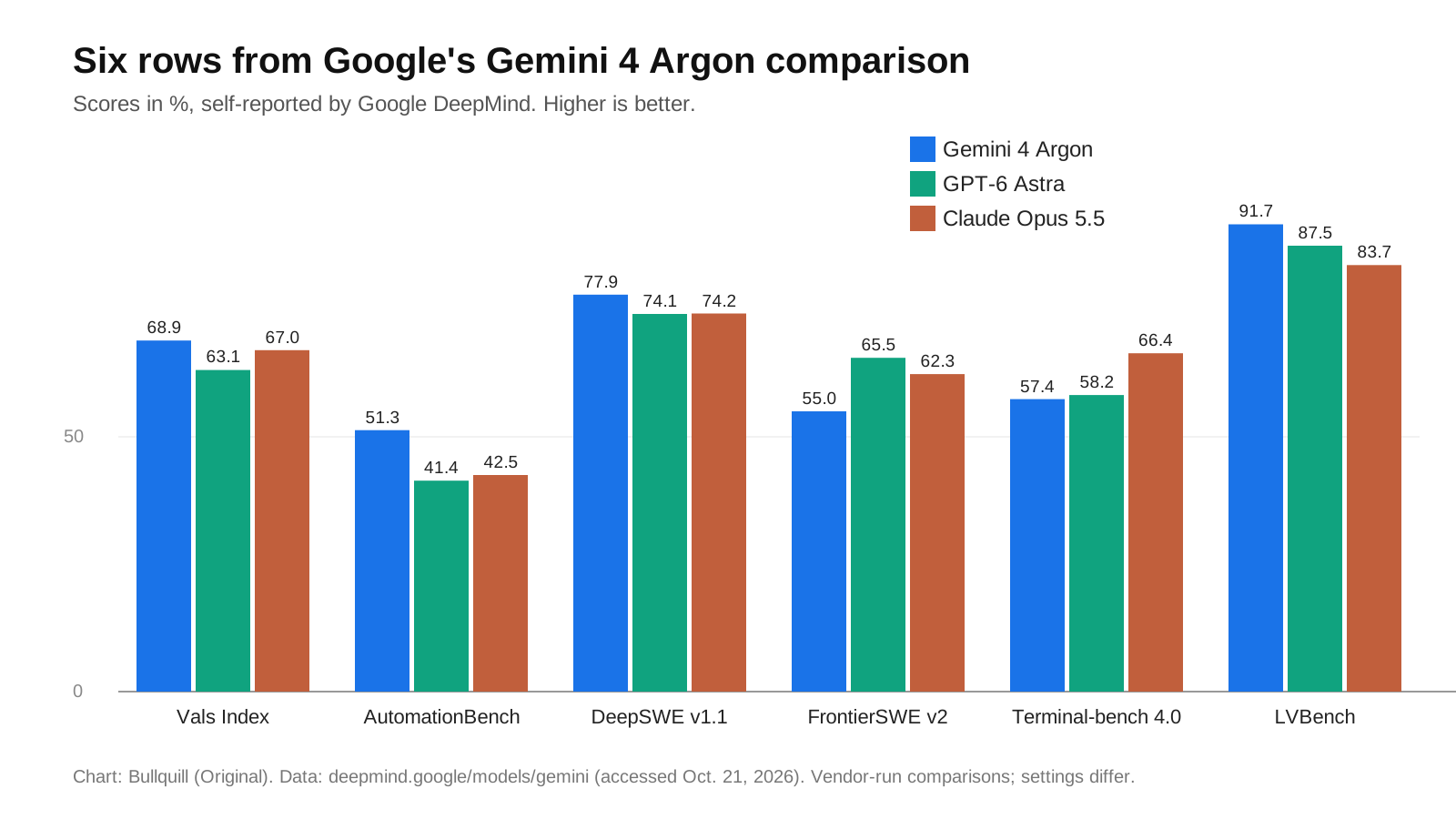
The pattern is clear enough: Argon is strongest on knowledge-work automation, long-context retrieval and video understanding, and is competitive but not dominant on agentic coding. Anthropic's Opus 5.5 leads on Terminal-bench 4.0, and OpenAI's Astra leads on FrontierSWE v2 and the science terminal test. The biggest single gap is on long-context retrieval between 256,000 and 1 million tokens, where Argon's 84.2% is more than 12 points ahead of the next model on Google's table.
The harder question is how far to trust any single table. When companies test rival models themselves, they choose the settings, the tool access and the effort level. The same benchmark can then produce different numbers for the same model depending on who ran it:
| Model and benchmark | Google's table | Anthropic's announcement |
|---|---|---|
| Opus 5.5 on AutomationBench | 42.5% | 40.0% |
| Opus 5.5 on Terminal-Bench Science 0.1 | 63.3% | 58.7% |
| GPT-6 Astra on Terminal-Bench Science 0.1 | 68.1% | 64.6% |
| GPT-6 Astra on Terminal-bench 4.0 | 58.2% | 57.9% |
Anthropic itself notes that some of its scores were reported at different effort levels. Independent leaderboards help but do not settle the matter. Vals.ai, which runs the Vals Index, listed Argon at 68.90% and first of 41 models in a September 30 update, while its model page later showed a slightly different score and rank, an example of how quickly these rankings move as models and test suites are refreshed. Vals also reported that Argon cost less per test than Opus 5.5 on its index.
What the pricing means in practice
Per-token prices are easier to compare with a worked example. Take a request with 100,000 tokens of input and 10,000 tokens of output, typical of a large document review, and ignore caching:
| Model | Input cost | Output cost | Total per request |
|---|---|---|---|
| Gemini 4 Argon (to Nov. 30) | $0.20 | $0.10 | $0.30 |
| Gemini 4 Argon (from Dec. 1) | $0.40 | $0.20 | $0.60 |
| Claude Opus 5.5 | $0.40 | $0.20 | $0.60 |
| GPT-6 Astra | $1.00 | $0.50 | $1.50 |
Bullquill calculation from list prices. Real bills depend on caching, batch discounts and, importantly, reasoning tokens.
The last point matters. Google's documentation says Argon's thinking tokens are billed as output, even though the API returns only a summary of the reasoning, and the default thinking level is "medium." A hard problem can therefore generate far more billable output than the visible answer suggests. The same logic applies, in different ways, to the other reasoning models: Anthropic's Opus 5.5 announcement says thinking can no longer be switched off on that model.
Elsewhere this week
Google was not the only lab shipping. DeepSeek posted a minor update, DeepSeek-V4.1-Flash-1017, on Hugging Face under the MIT license, listing a 1-million-token context and benchmark gains over the previous Flash release, and published an open-source inference framework called DeepInfer that drew heavy attention on Hacker News. In DeepSeek's own published table, the open-weight model still trails Anthropic's older Opus 5 on tests such as Humanity's Last Exam without tools, but edges past it on DeepSWE v1.1, a sign that the gap on agentic coding is narrowing. The Chinese lab's ambitions have since been underlined by a reported $15 billion funding round backed by Tencent and CATL.
On the OpenAI side, the company has also been widening its developer platform beyond the flagship model; our report on the OpenAI Decisions API reaching general availability covers what changed. And for teams that would rather adapt a smaller open-weight model than pay flagship prices, our guide to fine-tuning an LLM with LoRA on a single GPU walks through the alternative.
Impact: what it means
For developers. Argon is the cheapest of the three flagships until November 30. Teams that want to test it at the lower price have about six weeks. Anyone building on it should budget at the December price and set thinking levels deliberately.
For enterprises. The specs are converging: all three models now offer context windows around 1 million tokens and pricing in the same range, apart from Astra's premium. The decision is increasingly about which model does best on your own workload, and about data handling and regional availability, rather than headline scores. Domain-specific tests can tell a different story from general leaderboards: in a peer-reviewed study, a Microsoft AI diagnostic system outscored generalist doctors on difficult case records, with much of the gain coming from the underlying frontier models. Some employers are already reorganising around these tools, as Barclays' plan to cut 5,000 roles while leaning on AI shows.
For the market. Google's introductory price puts pressure on OpenAI's higher list price. According to Anthropic's Opus 5.5 announcement, the company cut Opus pricing with version 5.5, from $5 and $25 to $4 and $20. The direction of travel is lower prices for a given level of capability.
For safety policy. Google's staged release, with a guardrail-free version for vetted cyber defenders and participation in a US government pre-release process, shows how labs are now handling the most capable models: limited access first, wide release later.
Frequently asked questions
When was Gemini 4 Argon released?
Google announced it on September 30, 2026, initially for vetted cyber defenders. Broad access for Google AI Pro and Ultra subscribers and paid API customers began on October 13, 2026.
How much does the Gemini 4 Argon API cost?
On the standard paid tier, $2 per million input tokens and $10 per million output tokens through November 30, 2026, then $4 and $20 from December 1. Cached input is $0.10, rising to $0.20. Batch and Flex are half price. It is not on the free tier.
What is Gemini 4 Argon's context window?
1,048,576 tokens, shared between input and output. Default output is capped at 65,536 tokens; long decode in background mode allows up to about 1 million output tokens.
Is Gemini 4 Argon better than GPT-6 Astra and Claude Opus 5.5?
On Google's own table it leads most rows, but GPT-6 Astra leads on FrontierSWE v2 and Terminal-Bench Science and Opus 5.5 leads on Terminal-bench 4.0. Vendor-run results differ for the same models, so test on your own workload.
Are thinking tokens billed?
Yes. Google's documentation says Argon's thinking tokens are billed as output tokens, even though the API returns only a summary of the reasoning.
Sources
- Google: Gemini 4 Argon, our next era of frontier intelligence (Sept. 30, 2026)
- Google: Gemini 4 Argon is now available in the Gemini app (Oct. 13, 2026)
- Google DeepMind: Gemini model page and benchmark table
- Google AI for Developers: Gemini 4 Argon model page
- Google AI for Developers: Gemini API pricing
- OpenAI developer docs: GPT-6 Astra
- Anthropic: Claude Opus 5.5 announcement
- Anthropic: Claude pricing
- Vals.ai: Gemini 4 Argon results
- Hugging Face: DeepSeek-V4.1-Flash-1017 model card


