MKTMarketsMarket close NO. ---
Forex brief: dollar steadies near 101.7 as yen and euro stay weak
The dollar index slipped to a three-week low on October 20, then steadied as oil rebounded. We look at the euro, yen, pound, yuan and rupiah, the central-bank meetings ahead and the political risks from the US midterms to the UK Budget.

Data as of: US close on Tuesday, October 20, 2026 (Capp Notes); early Asian trading on Wednesday, October 21, as shown by Trading Economics at about 02:30 UTC; ECB euro reference rates (published around 16:00 CET) for October 20. Currency quotes change continuously and differ slightly between providers.
Key takeaways
- The US Dollar Index (DXY) fell 0.26% to 101.71 on October 20, near a three-week low, then held around 101.8 in early Asian trading on October 21 as oil rose again.
- The euro traded near $1.12–$1.124, close to multi-month lows, as unrest in France added to energy and growth worries.
- USD/JPY stayed near 158. The Bank of Japan, which raised its rate to 1.25% in September, meets on October 29–30.
- Sterling hit a one-month high near $1.34 after strong UK jobs data. September inflation figures are due on October 21, and the UK Budget follows on October 28.
- The yuan held near 6.68 per dollar, its strongest since 2022. The rupiah was around 17,940–17,990 per dollar, depending on the source and time, ahead of Bank Indonesia's rate decision on October 21.
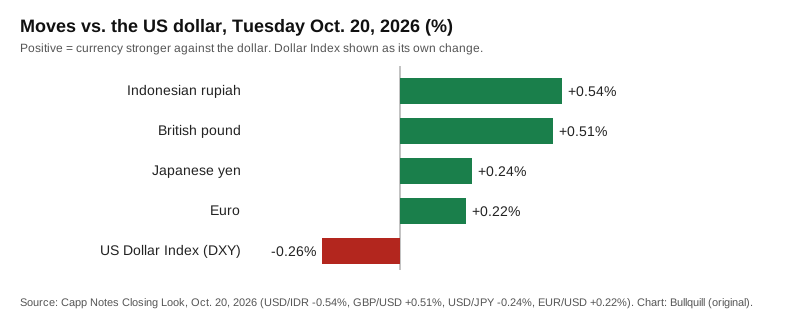
Session recap
| Pair | US close, Oct. 20 | Change | Early Asia, Oct. 21 | ECB-implied, Oct. 20 |
|---|---|---|---|---|
| US Dollar Index (DXY) | 101.71 | -0.26% | about 101.78 | n/a |
| EUR/USD | 1.1240 | +0.22% | about 1.1227 | 1.1215 |
| USD/JPY | 158.14 | -0.24% | about 158.2 | 158.13 |
| GBP/USD | 1.3376 | +0.51% | about 1.3373 | 1.3347 |
| USD/CNY | n/a | n/a | about 6.679 | 6.678 |
| USD/IDR | 17,943 | -0.54% | about 17,961 | 17,985 |
Sources: US close from Capp Notes. Early-Asia levels from Trading Economics market tables (no exact time shown). ECB-implied rates are Bullquill calculations from the ECB's euro reference rates (for example, USD/JPY = EUR/JPY 177.34 ÷ EUR/USD 1.1215); they are daily reference rates published around 16:00 CET, not traded prices.
The Federal Reserve's H.10 release of October 19 (data for October 16), for comparison, put the euro at $1.1231 and the yen at 158.00 per dollar.
What drove it
US rates and the Fed
Trading Economics linked Tuesday's dollar dip to AI-related stock worries, lower oil and weak housing data. The 2-year Treasury yield, which tracks Fed expectations, still rose to 4.79%. The Fed raised rates to 3.75%–4.00% in September; markets priced a hold on October 28 as most likely, with a further hike by year-end seen as probable. On October 21 the dollar firmed as oil rebounded after a diplomat said a US–Iran deal was not imminent.
Energy and geopolitics
Brent settled at $108.79 a barrel on October 20 and was trading near $110 early on October 21, according to Reuters and Trading Economics. High oil prices tend to weigh on currencies of energy importers such as the euro, the yen and the rupiah. Kpler counted at least 18 vessels attacked around the Strait of Hormuz in two weeks.
Europe and the UK
French authorities imposed curfews in several cities after anti-government protests, Trading Economics reported, raising doubts about fiscal consolidation. The ECB raised its deposit rate to 2.50% from September 16. In Britain, unemployment unexpectedly fell to 4.7%, and markets now expect the Bank of England to raise Bank Rate to 4% on November 5. BoE policymaker Megan Greene said policy “is not restrictive enough,” FXStreet reported.
Japan, China and Indonesia
Governor Kazuo Ueda said underlying inflation is nearing the 2% target, but the yen stayed weak because Japanese rates remain far below US rates. In China, the central bank's daily fixing near 6.72 on October 20 was weaker than the Reuters estimate, which Trading Economics read as a brake on the yuan's rise. In Indonesia, the rupiah weakened past 18,050 on October 16 after MSCI proposed reclassifying the market as “Standalone.” A Bank Indonesia official said swap and domestic NDF instruments had drawn about $8–8.5 billion of inflows.
Political & policy watch
- US midterms, November 3. President Trump has said the US will not strike Iran before the vote, Al Jazeera reported. The election outcome could shape fiscal and tariff policy, both of which affect the dollar.
- Tariffs. Section 301 tariffs of 10% or 12.5% on 60 economies replaced an expired Section 122 tariff in July. China faces the highest effective rate among major partners, 24.3%, per the Penn Wharton Budget Model.
- Japan. Finance Minister Satsuki Katayama warned on October 15 that Tokyo was ready to intervene again, Trading Economics reported, referring to a joint intervention with Washington in July.
- UK fiscal policy. The UK Budget is due on October 28; Pensions Age and Bloomberg identify the Chancellor as John Healey.
- Indonesia. Bank Indonesia's two-day meeting ends on October 21, with its rate at 5.75% after 100 basis points of hikes this year.
What it means
Analysis. Currency markets are trading interest-rate gaps and energy costs at the same time. Four major central banks meet within eight days, so relative policy expectations could shift quickly.
How equities reacted: our Indonesia stocks brief for October 22 covers the IHSG's 1.12% rise as the rupiah slipped, and in Tokyo, the Nikkei fell 2% as the AI selloff deepened and banks slid.
What to watch next
- October 21, 06:00 UTC: UK September CPI (consensus 3.4%, prior 3.1%, per TD Economics).
- October 21, Jakarta afternoon: Bank Indonesia policy decision.
- October 22, 8:30 a.m. ET: US initial jobless claims.
- October 22, 23:30 UTC: Japan September national CPI (consensus 2.1%, prior 1.9%).
- October 28: FOMC decision and UK Budget. October 29: ECB decision and press conference.
- October 30: Bank of Japan decision and Outlook Report. November 3: US midterms. November 5: Bank of England.
For the full week, see our dollar index weekly brief to Oct. 23.
Risk checklist for readers
- Read the quote direction. A higher USD/JPY means a weaker yen; a higher EUR/USD means a stronger euro.
- Fixings are not market prices. ECB reference rates, Jakarta's JISDOR and China's daily fixing are set once a day and can differ from live quotes.
- Intervention risk. Official action can move a currency several percent within minutes.
- Leverage cuts both ways. Margin trading magnifies gains and losses.
Frequently asked questions
Where was the US dollar index on October 20 and 21, 2026?
The DXY closed at 101.71 on October 20, down 0.26%, according to Capp Notes, and was around 101.8 in early Asian trading on October 21, according to Trading Economics.
Why are the yen and the euro weak?
Japanese interest rates remain far below US rates even after the Bank of Japan raised its rate to 1.25% in September. The euro has been weighed down by high energy costs, growth worries and unrest in France. High oil prices tend to hurt energy-importing economies.
Which central bank meetings are coming up?
Bank Indonesia decides on October 21, the Fed on October 28, the ECB on October 29, the Bank of Japan on October 30 and the Bank of England on November 5.
What is the difference between an ECB reference rate and a market rate?
The ECB publishes euro reference rates once a day around 16:00 CET for information. Market rates trade continuously and can differ. Bullquill's ECB-implied cross rates are calculations from those reference rates, not traded prices.
Does this brief recommend currency trades?
No. It explains currency moves and their drivers using published data. It does not recommend any trade, level or strategy and is not investment advice.
Sources
- Capp Notes: Closing Look, Tuesday, October 20, 2026
- European Central Bank: Euro foreign exchange reference rates
- European Central Bank: Key interest rates
- European Central Bank: Governing Council meeting calendar
- Federal Reserve: H.10 Foreign Exchange Rates, release of October 19 (data for October 16)
- Bank of Japan: Monetary Policy Meeting schedule
- The Nation: Bank of Japan lifts rate to 1.25% on September 18
- Trading Economics: US dollar index
- Trading Economics: Euro
- Trading Economics: Japanese yen
- Trading Economics: British pound
- Trading Economics: Chinese yuan
- Trading Economics: Indonesian rupiah
- FXStreet: Global rate hike risks loom (Oct. 20, 2026)
- Reuters via Yahoo Finance: Oil prices, October 20, 2026
- Al Jazeera: Trump says US will not strike Iran before midterms
- Penn Wharton Budget Model: Effective tariff rates, October 14, 2026
- Pensions Age: Chancellor confirms first Budget on October 28
- Bloomberg: Healey plans to raise UK taxes on banks
- TD Economics: Upcoming economic releases
Risk warning: Currency and derivative trading is high-risk, especially with leverage. You could lose some or all of the money you invest. Do your own analysis, and bear in mind that no product is suitable for everyone. Past performance does not guarantee future results.
This article is for information only and is not investment advice.


