GAMEGamesExplainer NO. ---
Power to the Players Act: would buying a game mean owning it?
Announced on October 15, 2026, the proposal would direct the FTC to write game ownership rules. Here is what it would do, why NBA 2K25 triggered it, and how similar efforts fared in California and the EU.

Key takeaways
- On October 15, 2026, US Representative Ritchie Torres announced the Power to the Players Act, which would direct the Federal Trade Commission to write rules so that buying a video game means owning it, not renting a revocable license.
- The bill would also require games with online features to offer an offline mode before their servers are shut down, and would preserve players' ability to resell their games.
- The trigger was NBA 2K25: Torres's office says the game, sold at $69.99, leaves digital stores on October 30 and loses its online servers on December 31, about two years after launch.
- As of October 24 the bill had no published number or text, and similar efforts have struggled: a California bill stalled in a state Senate committee in June, and the European Commission declined to legislate after a citizens' initiative signed by 1.29 million people.
- For now, the clearest protection in the US is disclosure: since January 2025, California has required sellers to say plainly when a "purchase" is only a license.
What is the Power to the Players Act?
The Power to the Players Act, announced by US Representative Ritchie Torres on October 15, 2026, would direct the Federal Trade Commission to write rules so that buying a video game means owning it, not renting a revocable license. As of October 24, 2026, no bill number or text had been published, and coverage through October 20 described it as not yet formally introduced.
This explainer covers what the proposal would do, why it emerged now, how similar efforts have fared elsewhere, and what it would mean for players and publishers if it ever became law.
What the bill would require
According to the announcement on Torres's House website, the bill would instruct the Federal Trade Commission, the US consumer protection agency, to issue regulations protecting people's ability to own and play the video games they buy. It has three core elements:
- Ownership, not a license. Buying a game would confer ownership of that game rather than a license to play it.
- An offline mode before shutdown. Games with online features would have to offer a way to play offline before the servers they depend on are switched off.
- Resale. Players would keep the ability to own and resell their games.
"When you pay for a game, you should own it," Torres said in the release, adding that consumers must have "the right to own, the right to play, and the right to transfer the games they buy." In an interview with Kotaku cited by Engadget, he described the idea as a return to the historical norm and suggested similar protections could later extend to digital books, movies and music.
Would servers have to stay online?
No. As announced, the bill asks for an offline mode before servers are switched off, not for publishers to keep servers running indefinitely. Ars Technica, as cited by Stevivor, noted the difference: earlier "keep it running" proposals drew criticism over cost, while an offline requirement shifts the burden to a one-time end-of-life patch.
What is still unknown
Important details are not yet public. Engadget reported that the bill had not been formally introduced as of October 15 and that Torres's office had not shared a draft. That means the precise scope is unknown: for example, whether it would cover games bought before the law took effect, or how "offline mode" would be defined for games built entirely around online play.
Bill status and sponsors
The Power to the Players Act is a proposal, not law. Torres's October 15 release says he "will introduce" it; it names no cosponsors and no supporting organizations. The Next Web, citing Kotaku, reported that Torres did not confirm cosponsors or Republican backing. Some outlets, including Tom's Hardware and Shacknews, described the bill as already introduced, but Torres's own release and Engadget's reporting describe a bill still to be filed.
| Step | Status as of Oct. 24, 2026 |
|---|---|
| Public announcement | Done, Oct. 15, 2026 (Rep. Ritchie Torres, D-NY, 15th district) |
| Formal introduction and H.R. number | No bill number or text published |
| Cosponsors | None named |
| Committee referral | Not yet; FTC-related consumer bills usually go to House Energy and Commerce |
| House and Senate votes, presidential signature | Not scheduled |
| FTC rulemaking (if enacted) | Would follow after the law passes |
Sources: Rep. Torres's office; Engadget; The Next Web. Committee assignment is the usual path, not a confirmed referral.
Once the bill is filed, it will appear on Congress.gov under Torres's sponsored legislation with its text, cosponsors and committee.
Why now: the NBA 2K25 example
Torres's office points to NBA 2K25, the basketball game released in 2024. The standard edition sold for $69.99 and the All-Star Edition for $99.99, according to the release. According to Torres's office, the game is due to be delisted from digital storefronts on October 30 and to have its online servers shut down on December 31. Annual sports titles are routinely replaced by the next year's edition, but the shutdown means that online modes people paid for will stop working roughly two years after launch.
The broader trend is the shift to digital. A boxed disc can be lent or resold. A digital purchase is usually governed by terms of service that describe it as a license, which the seller can limit or end. The question the bill raises is whether that distinction is clear to buyers, and whether it is fair.
How it compares with California AB 2426 and Stop Killing Games
| Jurisdiction and measure | What it does | Status |
|---|---|---|
| California, AB 2426 | Sellers must clearly disclose when buying a digital good, including games, grants only a license, and link to the license terms | Signed Sept. 24, 2024; in effect since Jan. 1, 2025 |
| California, AB 1921 ("Protect Our Games Act") | For games sold from 2027, 60 days' notice before ending required services, then an alternate version, a patch or a refund | Passed the Assembly; "failed passage, reconsideration granted" in a Senate committee on June 29, 2026 |
| European Union, "Stop Destroying Videogames" citizens' initiative | Asked the Commission to propose a law keeping games playable after support ends | 1,294,188 verified signatures; submitted Jan. 26, 2026; Commission declined to legislate on June 16, 2026 |
| Pennsylvania, proposed "Protect Our Games Act" | At least 60 days' notice before ending access or changing features, then a remedy such as offline play, a patch or a partial refund (reported floor of 25% of the original price) | Co-sponsorship memo circulated by state Sen. John Kane on Sept. 18, 2026; not yet introduced as a bill |
| United Kingdom, Stop Killing Games petition | Debated in Parliament | Government said in November 2025 it had no plans to change consumer law on this point |
| United States, Power to the Players Act | FTC rules on ownership, offline mode and resale | Announced Oct. 15, 2026; not yet introduced at announcement |
Sources: Greenberg Traurig on AB 2426; iXBT.games and The Next Web on the Pennsylvania memo; CalMatters Digital Democracy record for AB 1921; European Citizens' Initiative portal and European Commission; Lewis Silkin on the UK debate; Rep. Torres's office and Engadget.
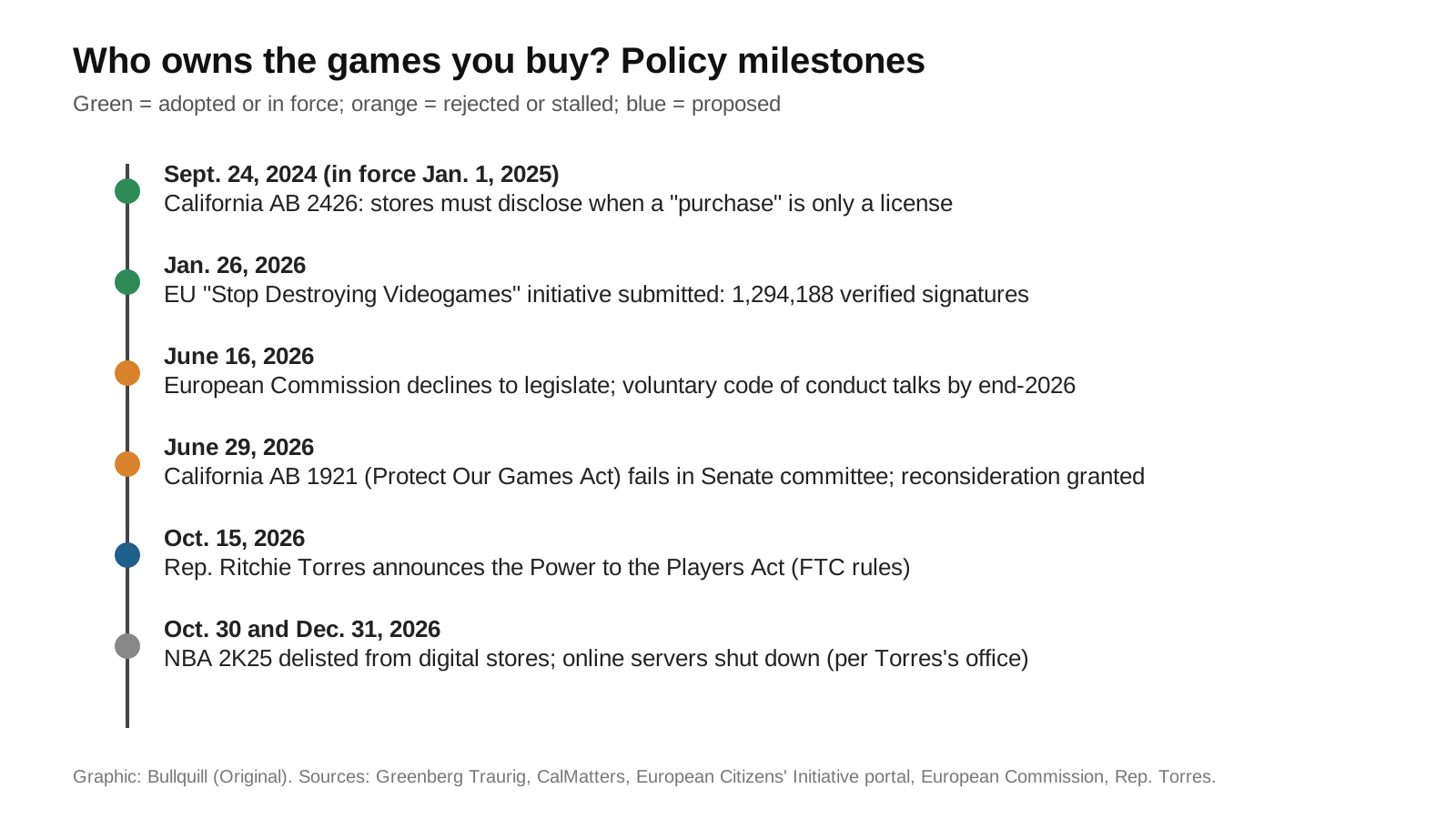
Side by side: what each measure requires
| Requirement | Power to the Players Act (US, proposed) | California AB 2426 (in force) | California AB 1921 (stalled) | EU Stop Destroying Videogames (no law) |
|---|---|---|---|---|
| Purchase counts as ownership | Yes | No; only disclosure that it is a license | No | Not requested as such |
| Clear license disclosure at checkout | Not specified | Yes | No | Already required by EU consumer law, per the Commission |
| Playable after servers close | Offline mode before shutdown | No | Alternate version, patch or refund | Requested; Commission plans a voluntary code instead |
| Advance notice of shutdown | Not specified | No | 60 days | Voluntary code under discussion |
| Resale or transfer | Yes | No | No | No |
| Who enforces | FTC rules | California false advertising and unfair competition laws (civil penalties up to $2,500 per violation) | Not specified in the record cited | None binding |
Sources: Rep. Torres's office; Greenberg Traurig; CalMatters Digital Democracy; European Commission.
The European decision is the most instructive. The Commission said it could not, at this stage, propose a legal obligation to keep games playable after they stop being provided commercially. It cited copyright and other intellectual property rights, which give rights holders control over how their works are licensed and when licenses end. It also argued that existing EU consumer law already offers safeguards: sellers must disclose contract duration and termination conditions, and under the Digital Content Directive consumers may be entitled to a proportionate refund when content does not match what was promised. Instead of a law, it promised talks with industry and consumer groups by the end of 2026 on a voluntary code of conduct for the end of a game's life, and a report on how the directive applies to discontinued digital content.
California's AB 2426 took a narrower path that is already in force. Sellers must either get the buyer's affirmative acknowledgment that the transaction is a license, or show a clear notice before checkout with a link to the full terms. Violations can be pursued under the state's false advertising and unfair competition laws, with civil penalties of up to $2,500 per violation in government actions, according to Greenberg Traurig.
The obstacles in Washington
Turning an announcement into law in the US means formal introduction, committee review, votes in both chambers and a presidential signature. Most bills never leave committee. Engadget flagged two further problems. The Supreme Court's 2024 decision ending "Chevron deference" has narrowed how far agencies such as the FTC can stretch their authority, and a federal judge previously blocked the FTC's ban on noncompete agreements on the grounds that the agency lacked authority to make such a rule. A game-ownership rule could face a similar challenge.
Analysis: There is also a practical design problem. For a single-player game with some online features, an offline patch may be modest work. For a game built around shared servers, matchmaking and live services, creating a meaningful offline version can be expensive, and publishers may not hold all the rights to licensed content needed to keep distributing it. California's AB 1921 tried to address this by allowing a refund as one of the options. How the federal bill handles it will decide how much it actually changes.
Impact: what it would mean
For players. If enacted in something like its announced form, the bill would turn a vague expectation into an enforceable right: a game bought today would still be playable in some form after the publisher moves on. Resale rights would also restore some of the value that digital buyers give up compared with disc owners.
For publishers and platforms. Analysis: the cost would come in planning. Studios would need end-of-life plans from the start, budgets for offline patches and a pricing model that accounts for resale. Some could lean further into subscriptions, which California's AB 2426 already treats differently from purchases.
For game preservation. Studio closures sharpen the question of who keeps old games running; see EA's shutdown of BioWare. The Stop Killing Games campaign and the EU initiative it inspired argue that games which depend on servers disappear when support ends. Offline modes would keep at least part of that history playable.
For the global market. Publishers sell worldwide. A binding US rule, or a strong EU code of conduct, could become a de facto global standard. Lewis Silkin, a law firm, suggests the voluntary EU code could become a benchmark for enforcement, litigation and market expectations even without legal force.
What you can do now
- Read the license notice. In California, stores must tell you when a purchase is only a license. Elsewhere, the terms of service usually say the same thing in smaller print.
- Watch for end-of-service notices before buying older sports or live-service games late in their life cycle. Online-heavy launches such as Modern Warfare 4 depend on servers for most modes.
- Know when you are renting. Streaming offers such as Xbox Cloud Playtime sell hours of access, not a game, and hardware like the Midnight Black PS5 without a built-in disc drive pushes buyers further toward digital licenses.
- In the EU, know your remedies. The Commission says the Digital Content Directive may entitle you to a proportionate refund when digital content stops matching what was promised.
- Follow the bill. Once introduced, it will receive a number and a page on Congress.gov, where its text and committee assignment will be published.
Frequently asked questions
What is the Power to the Players Act?
A bill announced by US Rep. Ritchie Torres on October 15, 2026 that would direct the FTC to write rules so that buying a video game confers ownership rather than a license, require an offline mode before servers shut down, and preserve players' ability to resell games.
Has the Power to the Players Act been introduced or passed?
No. Rep. Ritchie Torres announced it on October 15, 2026 and said he will introduce it. As of October 24 no bill number, text or cosponsors had been published. It would still need committee review, House and Senate votes and a presidential signature.
Would the Power to the Players Act force publishers to keep servers online?
No. As announced, it would require games with online features to get an offline mode before their servers shut down, rather than requiring servers to run indefinitely. It would also protect the right to resell or transfer games.
Why is NBA 2K25 being mentioned?
Torres's office cites it as the example: the game, sold at $69.99 for the standard edition, is due to be delisted from digital stores on October 30 and have its online servers shut down on December 31, about two years after release.
Did the EU pass a law to stop games being shut down?
No. After the Stop Destroying Videogames citizens' initiative gathered 1,294,188 verified signatures, the European Commission said on June 16, 2026 that it could not propose a legal obligation at this stage. It plans talks on a voluntary industry code of conduct by the end of 2026.
Sources
- Rep. Ritchie Torres: Power to the Players Act announcement (Oct. 15, 2026)
- Engadget: NY congressman to introduce bill protecting video game ownership
- CalMatters Digital Democracy: AB 1921, Digital games: ordinary use
- Greenberg Traurig: AB 2426 requires clear licensing disclosures for digital goods
- European Citizens' Initiative: "Stop Destroying Videogames" submitted (Jan. 26, 2026)
- European Citizens' Initiative: Commission replies (June 16, 2026)
- European Commission: Commission will engage with industry following the initiative
- The Next Web: Power To The Players Act would make the games you buy yours to own
- Stevivor: Ritchie Torres announces Power To The Players Act
- Shacknews: Ritchie Torres introduces legislation to protect player ownership of games
- iXBT.games: Pennsylvania proposal for 60-day shutdown notices and refunds (Sept. 28, 2026)
- Lewis Silkin: Commission stops short of mandatory requirements


