ECONEconomyCountry analysis NO. ---
Indonesia capital flows split after MSCI shock sinks IHSG 11.6%
Foreign investors are selling Indonesian equities while short-term money still flows into Bank Indonesia's SRBI securities and government bonds. A look at MSCI's proposal, the market's reaction, the rupiah near Rp18,000 and reserves of $146.3 billion.

Indonesia capital flows are splitting in two. Foreign investors have sold close to Rp90 trillion of Indonesian equities in 2026, and the IHSG fell about 11.6% on October 16 after MSCI proposed Standalone status, while money flows into Bank Indonesia's SRBI securities. For the latest flows, see how IHSG foreign selling hit a record as the index sits 41% below its peak.
For informational purposes only, not financial advice. This article is for general information and education only. It does not take into account your personal circumstances. Bullquill is an independent publication, not a licensed financial adviser, broker or financial institution.
Key takeaways
- On October 15 (New York time), MSCI proposed moving Indonesia from Emerging Market to "Standalone" status. It said a downgrade to Frontier would not reflect "the depth of the market problems." The consultation runs to April 30, 2027, and a decision is due by June 30, 2027.
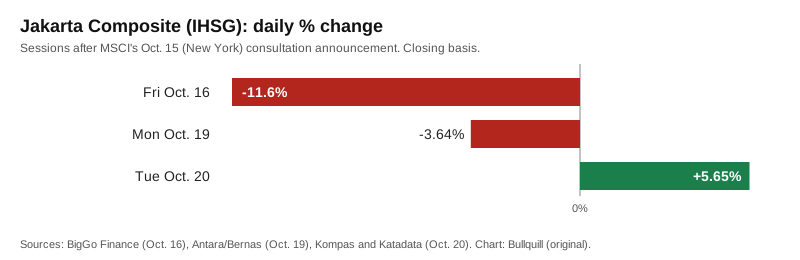
- The Jakarta Composite Index (IHSG) fell about 11.6% on October 16, its worst day since 1998, and another 3.6% on October 19. It rebounded 5.65% on October 20 even as foreign investors kept selling.
- Capital flows are splitting in two. Foreign investors have sold close to Rp90 trillion of Indonesian equities in 2026. Money has gone the other way into Bank Indonesia's SRBI securities and, to a lesser extent, government bonds (SBN).
- The rupiah is trading close to Rp18,000 per US dollar, near its June record low of 18,209. Reserves fell to $146.3 billion at the end of September.
- Bank Indonesia announces its rate decision on October 21. Economists are split between a hold at 5.75% and a 25-basis-point increase.
What MSCI proposed, and why it matters for flows
MSCI's index classification determines which benchmark a market belongs to, and therefore which funds have to own it. Its flagship emerging-markets index has about 1,200 constituents with a combined market capitalization above $10 trillion, according to AFP. Many passive funds track it, and active managers measure their performance against it. Leaving that benchmark can force passive funds to sell, and active managers who no longer need to hold the market often reduce their positions too.
In its release, MSCI said that market participants told it "sufficient progress has not been observed consistently" across the Indonesian market. It cited suspected coordinated trading and a lack of evidence of meaningful enforcement. In June, MSCI had said it would consider a consultation if progress was not evident by the November 2026 index review. Indonesian authorities had since announced reforms. These included disclosure of shareholders above 1%, more detailed investor classification, reporting of stocks with high shareholding concentration, and a roadmap to a 15% minimum free float. MSCI said investors wanted to see those measures applied consistently and to see evidence that they were working.
MSCI said it expects to go ahead with the reclassification unless the consultation finds "clear evidence of material improvements." Until further notice, it is also keeping a freeze on increases to Indonesian foreign-inclusion factors and share counts, on new additions to its Indonesia indexes, and on upward migration between size segments.
The Indonesia Stock Exchange (IDX) said it respects MSCI's independence and will seek clarification of the basis for the proposal. Its president director, Jeffrey Hendrik, stressed that the announcement starts a consultation and is not a final decision, according to Investortrust.
The market reaction in numbers
| Date (2026) | IHSG close | Daily change | Notes | Source |
|---|---|---|---|---|
| Fri, Oct. 16 | 5,185.11 | -11.6% (-679 points) | 30-minute trading halt after an 8% drop at the open; largest one-day fall since January 1998 | BigGo Finance; AFP via France 24 |
| Mon, Oct. 19 | about 4,996.6 | -3.64% | Opened about 4.3% lower | Antara; Bernas |
| Tue, Oct. 20 | 5,278.89 | +5.65% (+282.28 points) | 694 gainers, 111 decliners; turnover about Rp26.5 trillion; foreign net sell Rp2.19 trillion | Kompas; Katadata |
The October 19 level is derived from the October 20 close and point gain. AFP reported a drop of 11.1% when trading resumed on October 16 (an intraday figure). Katadata put total market capitalization at about Rp9,307 trillion on October 20.
The scale of the fall reflects a market that was already under heavy pressure. AFP reported that the IHSG was down more than 40% since the start of 2026 as of October 16. BigGo Finance put the decline at about 39% and described Indonesia as the world's worst-performing major market this year. October 20's broad rebound, with every sector higher and the LQ45 large-cap index up 8.58%, happened while foreign investors were still net sellers. Analysts quoted by Antara called it mainly a technical rebound.
Where the money is going: a split capital account
Indonesia's portfolio flows this year look very different depending on the asset. Foreign money has left equities but has gone into short-term central-bank paper and, to a lesser extent, government bonds.
| Instrument | Flow | Cut-off date | Source |
|---|---|---|---|
| Equities (IDX) | Rp92.11 trillion net sell | Oct. 20 | Katadata (exchange data) |
| Equities | about US$5.28 billion (Rp88.19 trillion as reported) net sell | Oct. 20 | Economists quoted by Kumparan (Permata Bank, CORE Indonesia) |
| Equities | Rp84.2 trillion outflow | early October | Finance ministry briefing (APBN Kita), via Suara |
| Government bonds (SBN) | Rp36.7 trillion inflow | early October | Finance ministry briefing, via Suara |
| Government bonds (SBN) | about US$2.37 billion inflow | Oct. 20 | Economist quoted by Kumparan |
| Bank Indonesia securities (SRBI) | Rp178.6 trillion inflow | early October | Finance ministry briefing, via Suara |
| Bank Indonesia securities (SRBI) | about US$10.33 billion inflow | Oct. 20 | Economist quoted by Kumparan |
| Total portfolio inflow | Rp131.1 trillion | Oct. 9 briefing | Finance ministry briefing, via Suara and Antara |
Figures come from different sources and dates and should not be added together. A single official weekly series was not available to us.
Analysis. SRBI are short-term instruments issued by Bank Indonesia to absorb liquidity and support the rupiah. Large foreign holdings of them can lift headline inflows, but this money can also leave quickly when the securities mature. Flows into equities usually reflect longer-term confidence in companies and the market. MSCI's decision targets those equity flows directly.
Estimates of index-driven selling
Estimates of how much money could leave vary widely and depend on assumptions about passive versus active funds. Trading Economics reported on October 16 that Goldman Sachs had earlier estimated outflows of up to $13 billion from a downgrade. BigGo Finance reported a UBS estimate of about $4 billion from passive funds alone. Bloomberg data cited by BigGo showed about $4.9 billion of net foreign equity outflows in 2026 already. These are projections by third parties, not forecasts by Bullquill, and the final outcome of MSCI's consultation is not known.
The rupiah, reserves and Bank Indonesia
| Indicator | Latest | Date | Source |
|---|---|---|---|
| BI-Rate | 5.75% (Deposit Facility 4.75%, Lending Facility 6.50%) | Decision of Sept. 22–23 | Bank Indonesia |
| Rupiah per US dollar | about 17,987 | Oct. 20 | Kumparan |
| Rupiah record low | 18,209 | June 2026 | AFP |
| Foreign-exchange reserves | US$146.3 billion | End-September | Bank Indonesia |
| CPI inflation | 3.28% y/y (core 2.84%) | September | BPS, via Investortrust |
| 10-year government bond yield | about 7.44% | Oct. 20 | Economist quoted by Kumparan |
| External debt | US$459.3 billion (+5.6% y/y) | August | Bank Indonesia |
The currency has absorbed much of the pressure. AFP reported that the rupiah weakened about 0.8% to around 18,060 per dollar on October 16, and that it is down roughly 8% this year. Reserves dipped to $146.3 billion at the end of September, from $146.5 billion a month earlier. Bank Indonesia cited debt repayments and its intervention to stabilize the rupiah. In its September decision, Bank Indonesia said that global investors' appetite for emerging-market portfolio assets "remains subdued." It pointed to a stronger dollar and the Federal Reserve's rate increase to 3.75%–4.00%.
That leaves Bank Indonesia with a difficult trade-off at its October 20–21 meeting. Bisnis.com's survey of 14 economists found 57% expecting a rate increase. Permata Bank's Josua Pardede put the chance of a 25-basis-point rise to 6.00% at about 60%. CORE Indonesia's Yusuf Rendy Manilet expected a hold with a more hawkish tone and said the odds were finely balanced. He also argued that a rate increase cannot fix the problem of opaque share ownership, so recovering investor confidence depends more on capital-market reform.
Outcome: Bank Indonesia held the BI-Rate at 5.75% on 21 October, against expectations of a hike to 6%, but raised its deposit facility rate to 5.00% and added hedging incentives and reserve cuts to support the rupiah.
Why it moved
- Market structure. MSCI's concerns about free float, concentrated ownership and suspected coordinated trading go beyond the economic cycle, and monetary policy cannot fix them.
- Global backdrop. US 10-year yields above 5%, Brent crude near $110 and a Fed that raised rates in September all reduce the appeal of emerging-market assets, especially for importers of oil.
- Positioning. After a year of foreign selling and a fall of about 40% in the index, local investors dominated trading, which can make moves bigger in both directions.
What it means
Analysis. Indonesia now has two capital stories at once. Short-term money is still coming in, attracted by central-bank and government paper with high yields. Equity investors, who provide long-term risk capital, are leaving. That pattern can keep reserves and the currency relatively stable in the short run while making the country more dependent on interest-rate differentials. If MSCI goes ahead in 2027, the equity outflows would likely be partly mechanical, and the size of active-fund selling is the main uncertainty. If authorities can show reforms being enforced before April 30, 2027, the consultation leaves room for MSCI to reconsider. Either outcome would affect borrowing costs, the rupiah and corporate funding well beyond the stock market.
What to watch next
- Bank Indonesia's decision, October 21: the rate, statements on intervention in the rupiah, and any measures aimed at portfolio flows.
- Regulators' response: enforcement actions by the IDX and the Financial Services Authority (OJK) on free float, concentrated ownership and trading conduct, and whether MSCI publishes an interim update during the consultation.
- MSCI's November 2026 index review, while the freeze on Indonesian index changes remains in place.
- October reserves data, due in early November, as a measure of how much intervention has cost.
- External drivers: the Fed meeting on October 27–28, US yields and oil prices.
Data notes
Equity outflow figures differ between sources (Rp84.2 trillion, Rp88.19 trillion and Rp92.11 trillion) mainly because their cut-off dates and methods differ. Some secondary reports gave different intraday levels for October 16 and 19; we used closing figures that match each other arithmetically. We have not seen Bank Indonesia's October decision, which had not been announced when this was written. Bullquill will update this article once it is published.
Risk warning: Stocks and bonds carry risk, including currency risk. Their value can fall, and you could lose some or all of the money you invest. Do your own analysis before deciding to use any product mentioned here, and bear in mind that it is not suitable for everyone. Past performance does not guarantee future results.
Frequently asked questions
What did MSCI propose for Indonesia?
On October 15, 2026 (New York time), MSCI launched a consultation on reclassifying the MSCI Indonesia Indexes from Emerging Market to Standalone Market status, citing investability concerns such as suspected coordinated trading and weak enforcement. Feedback is open until April 30, 2027, with a decision by June 30, 2027.
How much did Indonesian stocks fall?
The Jakarta Composite Index fell about 11.6% to 5,185.11 on October 16, 2026, its largest one-day drop since January 1998, and another 3.64% on October 19, before rebounding 5.65% to 5,278.89 on October 20.
Are foreign investors leaving Indonesia entirely?
Not across all assets. Foreign investors have net sold roughly Rp84 trillion to Rp92 trillion of equities in 2026, depending on the source and cut-off date, while recording inflows into Bank Indonesia's SRBI securities and government bonds (SBN).
What is Bank Indonesia expected to do?
Its board meets October 20–21, 2026. The BI-Rate was 5.75% after the September meeting. Economists surveyed by Indonesian media were split between a hold and a 25-basis-point increase to 6.00%. The decision had not been announced when this article was written.
Is this article advice on Indonesian assets?
No. It explains capital flows and policy using published data. It does not recommend buying, selling or holding any asset and is not investment advice.
Sources
- MSCI press release (Business Wire via Finviz): consultation on reclassifying Indonesia, Oct. 15, 2026
- AFP via France 24: Indonesian stocks dive 11% as MSCI weighs reclassification
- BigGo Finance: IHSG plunges and trading halted after MSCI proposal
- Investortrust: MSCI threatens rare Standalone demotion
- Trading Economics: Indonesian stocks sink 8% at open on MSCI downgrade risk
- Katadata: IHSG up 5.65% as foreigners net sell Rp2.19 trillion (in Indonesian)
- Kompas: IHSG closes at 5,278.89 (in Indonesian)
- Antara: IHSG closes 5.6% higher on post-correction buying (in Indonesian)
- Bernas: IHSG closes 5.65% higher at 5,278 (in Indonesian)
- Kumparan: BI-Rate projected to rise to 6% amid MSCI pressure (in Indonesian)
- Suara: Foreign capital inflow Rp131.1 trillion as of October 2026 (in Indonesian)
- Bisnis.com: majority of economists project BI-Rate increase (in Indonesian)
- Bank Indonesia: BI-Rate held at 5.75% (Sept. 23, 2026)
- Bank Indonesia: foreign-exchange reserves, September 2026 (in Indonesian)
- Bank Indonesia: news releases (external debt, August 2026)
- Investortrust: BPS September 2026 inflation 3.28% (in Indonesian)
This article is for information only and is not investment advice.


