WRLDWorldExplainer NO. ---
France riots explained: Europe's cost-of-living protests
France is under local curfews after the October 17-18 weekend, when peaceful marches were followed by looting and arson in Paris, Lyon and Limoges. Italy has sent 500 extra troops to Milan, and energy prices are up 18.9% on a year earlier.

Key takeaways
- France is under localized curfews after the weekend of October 17-18, 2026, when nationwide cost-of-living marches were followed by rioting, looting and arson, including a fire that largely destroyed the 19th-century town hall in Limoges.
- France's Interior Ministry put Saturday's turnout at about 550,000 people nationwide; organizers claimed far more. Most marchers protested peacefully, according to the Associated Press.
- The unrest is not only French. Protests over prices, wages, housing and tuition also hit Italy, Belgium, Portugal and Spain, and Italy has responded with an emergency decree and 500 extra troops for Milan.
- Official data shows why the anger is broad: Eurostat says euro area inflation rose to 3.8% in September 2026, driven by energy prices up 18.9% on a year earlier.
- The next big test is Saturday, October 24, when further demonstrations are planned in France.
France riots broke out over the weekend of October 17-18, when cost-of-living marches of about 550,000 people, by the Interior Ministry's count, were followed by looting and arson. Localized curfews are in place, and similar protests have hit Italy, Belgium, Portugal and Spain.
The violence has dominated the coverage, but it is only part of the story. Hundreds of thousands of people marched peacefully, and similar protests, mostly smaller, took place the same weekend in several other European countries. This explainer sets out what happened, what the governments and protest organizers say, and what the economic data shows.
How the French protests began
The movement started in mid-September, when high school students and teachers in the Paris suburbs began demonstrating over overcrowded classes, deteriorating buildings and teacher shortages, CBS News reported. On October 8, the Ministry of National Education announced it would deploy more than 3,000 substitute teachers to the high schools most in need and authorized several hundred additional hires.
The concession did not end the protests. Instead, the movement widened to include trade unions and activists from the 2018 "yellow vest" movement, turning it into a broader protest against high living costs, fuel prices and declining public services. On Saturday, October 17, nationwide demonstrations drew about 550,000 people, including roughly 110,000 in Paris, according to Interior Ministry figures reported by Euronews. Organizers were reported to claim about 800,000 (figure not independently confirmed).
What happened over the weekend
In several cities, groups broke away from the marches. In Limoges, masked protesters set a police car alight outside the town hall, broke in and started a fire, according to witnesses quoted by AFP via France 24. The roof collapsed onto the lower floors except the west wing. The city's mayor said no grievance could justify destroying public property. In Paris, police used tear gas and water cannon as shops were looted, and Paris Mayor Emmanuel Grégoire said whole streets had been "devastated," Al Jazeera reported.
| Indicator (France) | Figure | Source |
|---|---|---|
| Protesters nationwide, Saturday Oct. 17 | About 550,000 (official); about 800,000 (organizers) | Interior Ministry via Euronews; organizers via France 24 |
| Arrests over the weekend | About 2,400 | AP |
| People taken into custody by Monday evening | More than 2,500 | Justice Minister Gérald Darmanin via CBS News |
| Officers hurt (Lecornu's early tally) | About 150 | Al Jazeera |
| Businesses damaged or looted | "Thousands" | Authorities via AP |
| People maimed by police weapons in three weeks of protests | Six, including minors | Criminologist Sebastian Roché via AP |
Figures differ because they were issued at different times and by different authorities. The arrest numbers in particular have risen as cases were processed. AP reported that most criminal cases involve property damage, participating in a group formed to commit violence, and assaults on police.
How the French government responded
President Emmanuel Macron drew a line between peaceful protesters seeking better schools and working conditions and those who, in his words, had "hijacked" the protests. He blamed "insurrectionist elements from radical far-left groups, joined by numerous criminals," and promised an "uncompromising" response. He also ordered an inquiry into intelligence and planning failures that may have led authorities to underestimate the risk. Interior Minister Laurent Nuñez acknowledged that police lost control in some cities on Saturday.
Prefects, the state's representatives in each department, were told they could take any necessary measures, including banning gatherings. Overnight curfews were imposed around Place de la République and the Les Halles shopping district in Paris, and restrictions were introduced in Lyon and other cities, CBS News reported. Paris and Lyon reported no major incidents on Monday night, and authorities extended the measures. Prime Minister Sébastien Lecornu promised a "massive" police deployment before the October 24 demonstrations.
Not everyone accepts the government's explanation. Roché, a criminologist quoted by AP, argued that France's far-left fringe, estimated by French intelligence at about 3,000 people across loosely organized factions, is too small to account for violence on this scale on its own. He drew a distinction between activists who target symbols of capitalism, such as banks, and looters who go after sportswear and electronics shops. The looters' aim, he said, "is not symbolic. It is acquisitive." He also pointed to police use of non-lethal grenades and other riot-control weapons, which have come under sharp scrutiny.
The government says it will do two things at once: listen to the demands about schools and living costs, and prosecute those responsible for violence. Student organizations have called for more demonstrations and blockades, and activists seeking to revive the yellow vest movement have called nationwide protests under the slogan "Macron must go," AP reported.
Beyond France: a continent under price pressure
The same weekend saw protests in several other countries. Al Jazeera described them as separate, uncoordinated demonstrations with overlapping grievances: rising living costs, low wages, housing and, for students, education funding and job prospects.
- Italy. A march against wars and rising living costs turned violent in Milan, where police used tear gas and water cannon, with clashes also reported in Bologna. About 50 people, many of them minors, were detained in Milan, according to Al Jazeera. Prime Minister Giorgia Meloni said: "Demonstrating is a right. Setting our cities ablaze is not." On October 20, her government approved a decree, reported by Reuters, creating an offense of violent participation in a demonstration punishable by up to five years in prison and a fine of up to €20,000, making parents liable for damage caused by their minor children, and deploying 500 soldiers alongside police in Milan until the end of 2026.
- Belgium. Police in Brussels used tear gas and water cannon, accusing some protesters of throwing missiles and setting fires. Students there had already protested for weeks against university registration fees.
- Portugal. Tens of thousands marched in Lisbon in a protest called by the CGTP union, demanding higher wages and pensions and lower housing and fuel costs. A government minister said the government "will not yield to shouts from the street."
- Spain. Housing is the flashpoint. On October 3, tens of thousands marched in Madrid and about 50 other cities, a day after parliament voted down the minority government's emergency relief decrees for tenants, Al Jazeera reported. Spain also has the highest annual inflation rate of the countries in the table below.
What the data shows
Protesters' complaints vary from country to country, but the official numbers point to a common pressure. According to Eurostat, annual inflation in the euro area rose to 3.8% in September 2026, up from 3.2% in August and 2.2% a year earlier. Energy was the main driver: energy prices were 18.9% higher than in September 2025, while services inflation held at 3.2% and food, alcohol and tobacco slowed to 1.3%. Fuel prices appear directly in protesters' demands in France and Portugal.
| Country | Annual inflation, Aug. 2026 | Annual inflation, Sept. 2026 |
|---|---|---|
| Spain | 4.6% | 5.0% |
| Belgium | 4.2% | 4.5% |
| Italy | 3.2% | 4.2% |
| Portugal | 3.6% | 3.6% |
| France | 2.6% | 3.4% |
| Germany (for comparison) | 2.9% | 3.3% |
| Euro area | 3.2% | 3.8% |
Source: Eurostat, harmonized index of consumer prices, release of October 16, 2026.
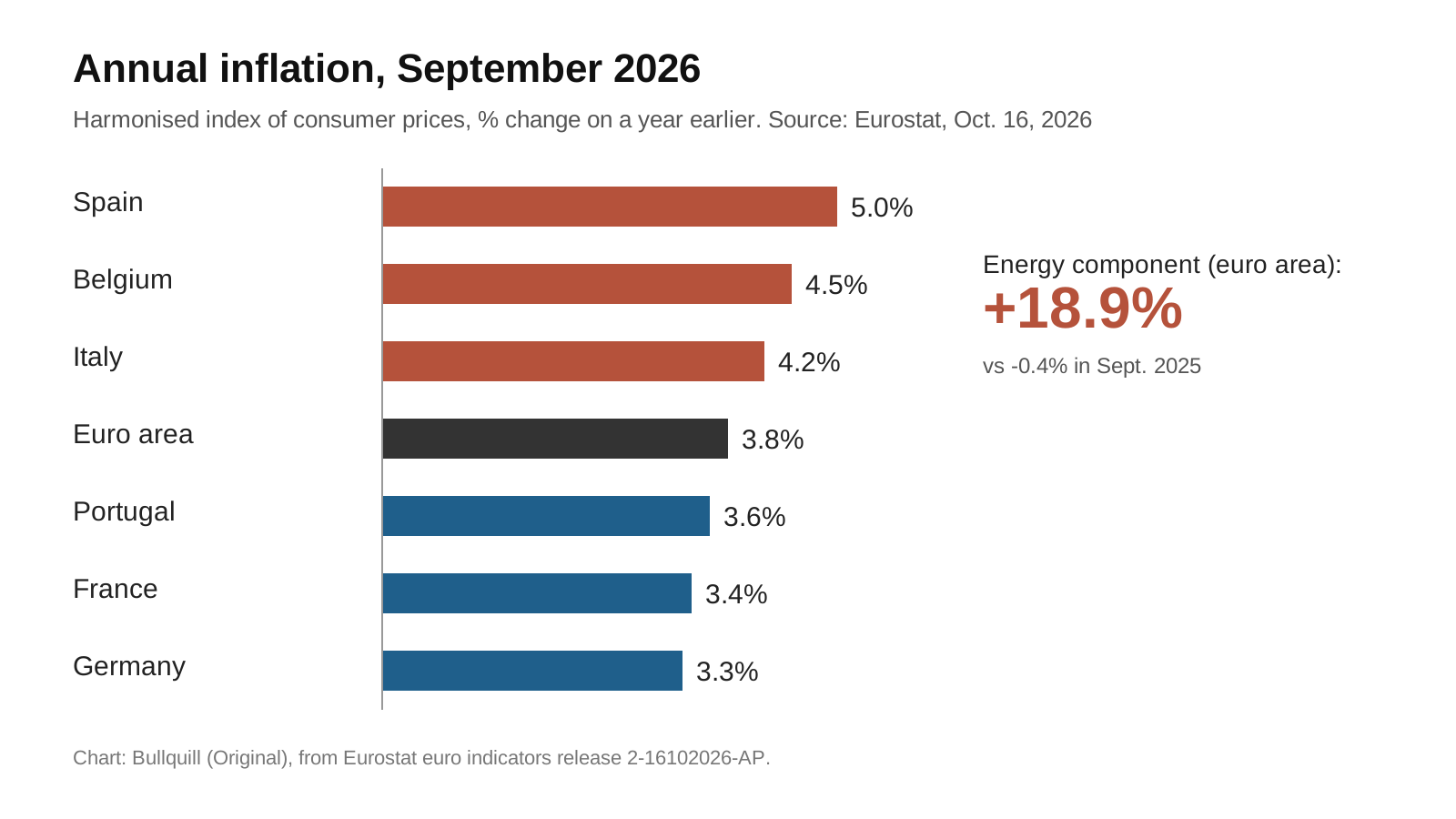
France's own inflation rate, at 3.4%, is below the euro area average, which suggests that its unrest is about more than prices. Public finances are part of the picture. CBS News, citing the national statistics agency, reported French public debt of nearly €3.6 trillion at the end of June, or 119% of annual economic output, with the 2026 deficit expected at 5.4%. Interest costs are projected to rise by €12 billion next year. That leaves the government little room for the spending that protesters are demanding on schools and services.
Impact: what it means
For French politics. Macron cannot run again, and the presidential election is due in April 2027. His camp lacks a parliamentary majority and pushed the 2026 budget through without a final vote. An Ipsos poll from October 7-8 put his approval at 15%, and September polling showed National Rally's Marine Le Pen leading first-round matchups. How the government balances concessions and policing will shape that race.
For civil liberties. Curfews, bans on gatherings and Italy's new offense widen the state's powers over public protest. Supporters say they are needed to separate peaceful marchers from rioters. Critics, including some criminologists, warn that heavy-handed policing can escalate tensions. France has been here before: AP recalls three weeks of rioting in 2005 that led to a state of emergency, the yellow vest movement of 2018, and the unrest that followed a police killing of a teenager outside Paris in 2023.
For households and businesses. Thousands of shops were damaged or looted, and the demonstrations planned for October 24 mean more disruption is possible. The underlying driver, energy-led inflation, is not something any single government can quickly reverse, and the fiscal position in France and elsewhere limits how much relief governments can offer.
What to watch
- Saturday, October 24: planned demonstrations in France, including student marches and a yellow-vest-style call for Macron to go.
- Italy's decree: it took effect immediately but must be approved by parliament.
- November 4: Eurostat's flash estimate of October inflation, which will show whether price pressure is easing.
Frequently asked questions
Why are people protesting in France?
The protests began in mid-September over overcrowded classrooms, deteriorating school buildings and teacher shortages, then widened into a broader protest against high living costs, fuel prices and declining public services, with trade unions and yellow vest activists joining.
How many people took part in the October 17 protests in France?
France's Interior Ministry put nationwide turnout at about 550,000, including about 110,000 in Paris. Organizers were reported to claim about 800,000 (figure not independently confirmed). AP reported that most marchers protested peacefully.
Are there curfews in Paris?
Yes. Overnight curfews were imposed around Place de la République and the Les Halles district, and restrictions were introduced in Lyon and other cities, CBS News reported. Authorities extended them after a calm Monday night. Check local prefecture notices for current hours.
Which other European countries have seen protests?
Italy, Belgium, Portugal and Spain. Violence was worst in Milan, where Italy has approved an emergency anti-riot decree and 500 extra troops. Lisbon saw a large union-led march, Brussels saw clashes, and Spain has had large housing protests.
How high is inflation in Europe right now?
Eurostat reports euro area annual inflation of 3.8% in September 2026, up from 3.2% in August. Energy prices were up 18.9% on a year earlier. Spain was at 5.0%, Belgium 4.5%, Italy 4.2%, Portugal 3.6% and France 3.4%.
Sources
- AP (via WRAL): How France's worst rioting in years erupted and how the government responded
- CBS News: French government extends curfews after riots sweep across the country
- Euronews: Spire collapses at historic Limoges town hall
- France 24 / AFP: Town hall in Limoges "largely lost" to blaze
- Al Jazeera: Cost of living protests hit Belgium, Italy, Portugal and France
- Al Jazeera: Tens of thousands protest in Spain after failed housing reforms
- Reuters (via aNews): Italy's Meloni approves tougher anti-riot laws after Milan violence
- Eurostat: Annual inflation up to 3.8% in the euro area (Oct. 16, 2026)


