POLPoliticsCountry analysisExplainer NO. ---
Alberta referendum: three in four vote to remain in Canada
Premier Danielle Smith, who voted to remain, has promised no further separation referendum while she leads the government, but separatist leaders say their campaign will continue. Official results are due October 29.

Key takeaways
- Albertans voted on October 19, 2026 to remain a province of Canada. Unofficial counts reported by Al Jazeera and CTV News put the "remain" option at roughly 75 to 76 percent.
- The ballot did not ask about independence directly. A win for the second option would only have started a process toward a later, binding separation vote.
- Nine other questions on immigration and the constitution produced much tighter results. Several were leading "yes" in partial counts, while the question on opting out of federal programs was trailing.
- Premier Danielle Smith, who voted to remain, has promised no further referendum on separation while she leads the government. Separatist leaders say their campaign will continue.
- The figures are not final. Elections Alberta lists Thursday, October 29, 2026 as the date for official results.
Albertans chose to remain a province of Canada in the Alberta referendum on October 19, 2026. Unofficial counts reported by Al Jazeera and CTV News put the "remain" option at roughly 75 to 76 percent; Elections Alberta lists October 29 for official results.
The result is a clear win for Prime Minister Mark Carney and for the cross-party campaign that pushed the "remain" question onto the ballot. It is also a reminder of how far the separatist movement has come from the margins: roughly a quarter of the people who voted backed a process that could have led to a second, binding vote on leaving. This explainer sets out what was decided, what was not, and what happens next.
The result in numbers
Counting was slower than planned. NBC News reported that more than 100 polling stations had to extend their hours after opening late, and Global News said the late openings pushed results back by more than three hours. Elections Alberta counted the separation question first and said it would finish the other nine afterward.
| Question 10: separation | Reported share | Source and point in the count |
|---|---|---|
| Option 1: remain a province of Canada | About 76% | Al Jazeera, citing preliminary results with about 1.8 million votes counted |
| Option 2: begin the process toward a binding separation referendum | About 24% | Same count |
| Option 1: remain | About 75% | CTV News projection, as reported in its live coverage |
| Mail-in ballots received | 519,082 | Elections Alberta figure reported by Global News; about ten times the 2023 level |
| Advance and special mail-in votes | More than 1.35 million | Global News; compared with about 810,000 in the 2023 provincial election |
The shares above are unofficial and come from different moments in the count, which is why they differ slightly. Turnout as a share of eligible voters had not been published in the sources we reviewed.
The geography was lopsided. CTV's live coverage reported that no riding in Edmonton or Calgary fell below 75 percent for remaining, and that 22 of Calgary's 26 ridings were above 80 percent. The only riding where a majority backed the second option, in partial results, was Central Peace-Notley in the province's northwest.
What voters were actually asked
The wording matters, because the vote was not a straight "leave or stay" decision. Question 10 offered two options. The first asked whether Alberta should remain a province of Canada. The second asked whether the provincial government should begin the constitutional process needed to hold a binding referendum on separation.
In other words, even a win for the second option would not have taken Alberta out of Canada. It would have triggered a longer process, and any eventual exit would still have required negotiations under Canadian constitutional law. Canada's Supreme Court ruled in 1998, in a case arising from Quebec's independence movement, that a province cannot secede unilaterally, and federal legislation known as the Clarity Act sets conditions for how Ottawa responds to a secession vote.
Critics on both sides argued that the two-option format was confusing. An Angus Reid survey in the spring found that about half of respondents described the question as confusing, even as most said they would vote to stay.
How Alberta got here
Alberta's grievances with Ottawa are old. Many Albertans have long felt that federal climate and energy policy was written against their interests. Premier Smith has repeatedly blamed former Prime Minister Justin Trudeau for fueling separatist sentiment. Former Premier Jason Kenney told NBC News that separatist parties historically won only 1 to 2 percent of the vote; the anger that grew during pandemic restrictions helped turn a fringe position into an organized campaign.
The legal path to Monday's vote ran through the province's Citizen Initiative Act, which lets residents force a referendum by petition. According to a Wikipedia summary of CBC, BBC and Global News reporting (not independently verified), two competing petitions emerged. A federalist campaign called Forever Canadian, led by former deputy premier Thomas Lukaszuk, gathered more than 400,000 signatures to put a "remain" question to voters. A separatist petition was later struck down by an Alberta court in May 2026, which found that Indigenous peoples had not been properly consulted on a question touching treaty rights. Soon afterward, Smith announced in a televised address that a remain-or-separate question would go on the ballot alongside other questions her government wanted to ask.
The campaign also drew attention from outside Canada. Al Jazeera reported that US Treasury Secretary Scott Bessent had described Alberta as Washington's "natural partner," and that Elon Musk posted that the province "should separate." Those remarks landed in a country already in a trade war with the United States and weary of talk from President Donald Trump about making Canada a 51st state. NBC News noted that those threats helped Carney build support in Alberta, where Liberal prime ministers have historically been unpopular.
The other nine questions
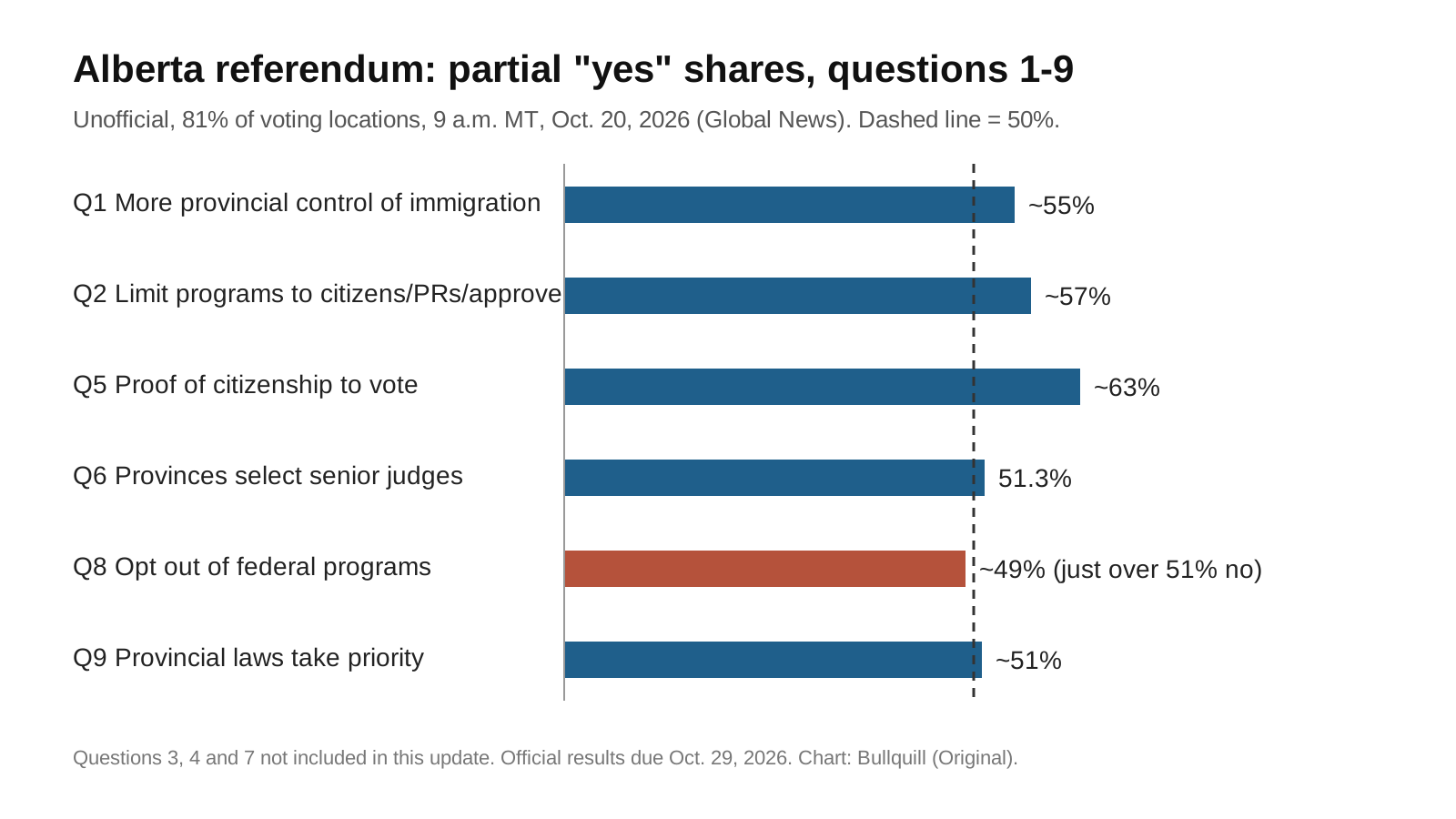
Separation dominated the headlines, but most of the ballot was about something else. Questions 1 to 5 dealt with immigration, access to public services and voter identification. Questions 6 to 9 asked whether Alberta should pursue constitutional changes, from provincial selection of senior judges to abolishing the federal Senate. Here the margins were much narrower.
| Question (paraphrased) | Partial result |
|---|---|
| 1. More provincial control over immigration | Nearly 55% yes |
| 2. Limit provincially funded programs to citizens, permanent residents and approved-status migrants | About 57% yes |
| 5. Proof of citizenship required to vote in provincial elections | About 63% yes |
| 6. Provinces, not Ottawa, select King's Bench and Appeal Court justices | 51.3% yes |
| 8. Opt out of federal programs while keeping federal funding | Just over 51% no |
| 9. Provincial laws take priority over conflicting federal laws | Nearly 51% yes |
Source: Global News, unofficial results from 81% of voting locations as of 9 a.m. MT on October 20, 2026. Questions 3, 4 and 7 were not reported in that update. CTV's live coverage reported "yes" leading on Questions 3, 4 and 7 at earlier points in the night.
These results carry political weight but little immediate legal force. CTV reported that experts expect most of the constitutional proposals to need broad provincial and federal consent, which makes quick changes unlikely. The immigration questions are more likely to shape negotiations: Carney said Ottawa and the provinces should set immigration levels together, and the federal government's immigration plan is due in November.
How the main players reacted
Carney welcomed the result, saying Albertans "chose unity." Smith posted her thanks to voters and said she would not hold another referendum on the issue while her government is in office. Lukaszuk, whose petition started the "remain" question, celebrated with a blunt "Don't mess with Canada!" according to Global News. Alberta NDP Leader Naheed Nenshi and Kenney both argued that the referendum should never have been called, and federal NDP figures pointed to a reported cost of about C$130 million.
On the other side, Jeffrey Rath of the Alberta Prosperity Project told reporters that the movement "isn't going anywhere." Another leader of the same group said he did not have much faith in the results and that the group would challenge them where it could. Separatists are also pushing for a leadership review of Smith inside her United Conservative Party, which could come at the party's November convention. Rath floated the idea of a new pro-independence party.
Canadian politics is also under scrutiny south of the border. The US embassy in Ottawa has accused Canadian ministers and premiers of trying to influence the November 3 US midterms, which Canada's leaders deny; our explainer on the US-Canada midterm interference dispute sets out both sides.
What it means
For Ottawa. A three-to-one margin is a strong mandate for Carney's approach, which has paired a harder line in the trade war with Washington with concessions to Alberta, including partnering with Smith on a new pipeline to export more Alberta bitumen overseas. Carney said the result lets the country focus on diversifying trade and major infrastructure, with Alberta at the center of an energy strategy.
For Smith. The premier campaigned to remain while giving separatists the vote they demanded. She now has a decisive answer to point to, but the activists who pushed her to call the referendum are inside her own party, and they are not accepting the result quietly. How the November convention handles calls for a leadership review will show whether the vote settled her party's internal fight or only the provincial one.
For the separatist movement. About a quarter of voters backed the second option. That is far above the 1 to 2 percent separatist parties used to win, but well short of a majority. A lawyer quoted by CTV said the separatists' citizen initiative could revive a separation vote if its court appeal succeeds, so the legal question has not entirely closed.
For investors and trading partners. The vote removes a tail risk that had attached itself to a major oil-producing region during a trade dispute with its largest customer. It does not remove the underlying grievances over energy policy and federal transfers that drove the campaign.
What to watch next
- October 29: official results from Elections Alberta, including any recounts.
- November: the UCP convention, where separatists want a review of Smith's leadership.
- November: the federal immigration levels plan, the first test of how Ottawa responds to the immigration questions.
- Courts: the separatist petition's appeal, which lawyers say is the main remaining legal route to another vote.
Frequently asked questions
Did Alberta vote on independence?
Not directly. Question 10 asked whether Alberta should remain a province of Canada or whether the government should begin the constitutional process toward a later, binding separation referendum. About three in four voters chose to remain, according to unofficial results.
When are the official Alberta referendum results?
Elections Alberta lists Thursday, October 29, 2026 as the date for official results. Figures reported on October 20 were unofficial and could change slightly, including through recounts.
Will there be another separation referendum?
Premier Danielle Smith has said she will not hold another referendum on the issue while her government is in office. Separatist groups say they will keep campaigning, and a lawyer quoted by CTV said a pending court appeal on the separatist petition could reopen a legal route.
What were the other referendum questions about?
Questions 1 to 5 covered immigration, access to provincially funded services and proof of citizenship to vote. Questions 6 to 9 asked about constitutional changes, including provincial selection of judges, abolishing the Senate and provincial opt-outs from federal programs. Partial results were much closer than on separation.
Do the constitutional questions change anything immediately?
No. Experts quoted by CTV said most of those proposals would need broad provincial and federal consent, so they are unlikely to take effect soon. They do give the Alberta government a political mandate in negotiations with Ottawa.
Sources
- Al Jazeera: Alberta voters reject separation from Canada, early results show (Oct. 20, 2026)
- Global News: Alberta referendum voters reject separatism, choose to stay in Canada
- Global News: Albertans mixed on other referendum questions after rejecting separation
- CTV News / CP24: Alberta referendum live updates
- NBC News: Alberta rejects move toward independence from Canada in a victory for Carney
- Elections Alberta: referendum results page and key dates
- Angus Reid Institute: views on the referendum question
- Wikipedia: 2026 Alberta independence referendum (background and timeline, used for context only)


